#84 Squarebot
”What’s that you are holding, Squarebot?”
“Square.”
I have met Squarebot before and am suspicious. “Are you sure, squarebot? I can see it must be a rectangle, because you have drawn it on squared paper. But I can’t count the squares without breaking social distancing rules. How wide is it?”
“16.”
Advertisement
“And its height?”
“16.”
“Sounds like a square, then. Just to check: what is its area?”
“289.”
“Hold on, that doesn’t work: 289 is 17 squared. You are rounding every numerical answer you say to the nearest square number, aren’t you? And if the answer isn’t a number you just say ‘Square’?”
“Square,” chuckles Squarebot.
“So the width might actually be 17? Or 18? Or 15? Or even 20?”
“Square,” grins Squarebot.
Can you think of a question to ask Squarebot to find out if the rectangle really is a square?
Answer next week
#83 Albatross
Solution
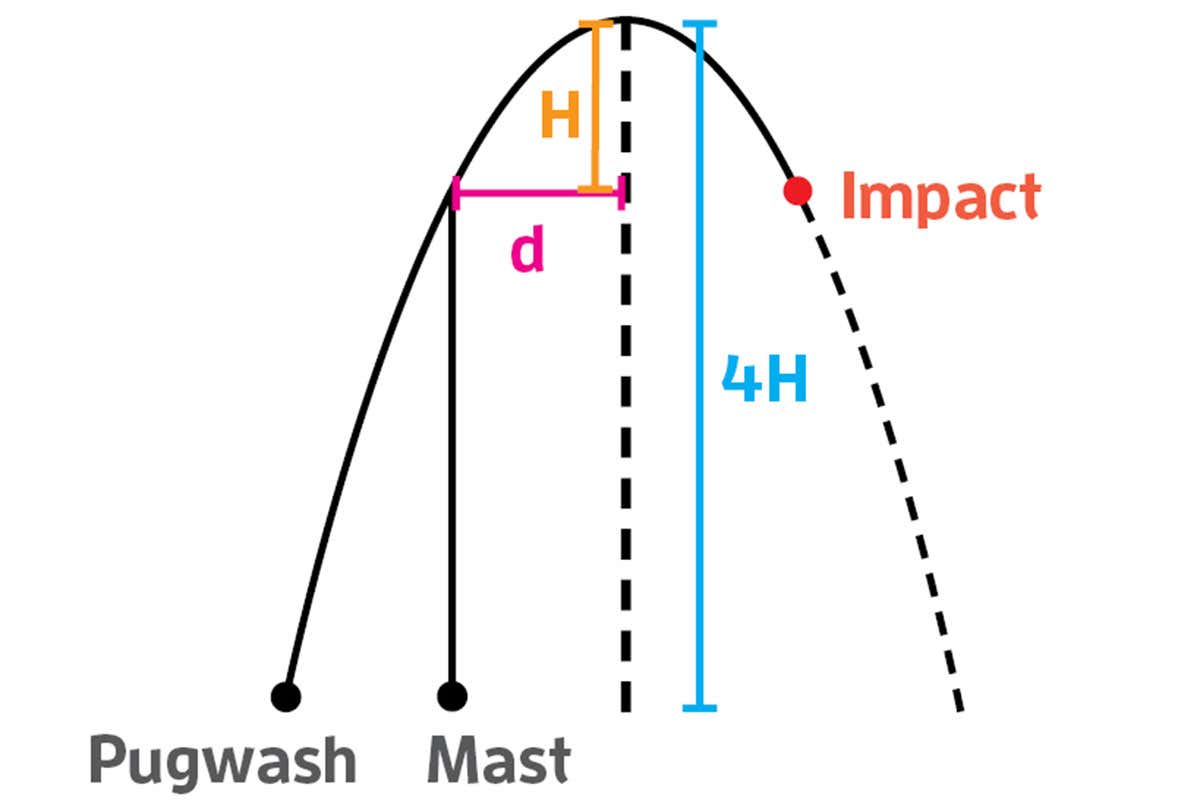
If we call the height of the mast 3H, the stone climbed H above that to be 4H above the ground at its peak. A parabola is a “square” function, so the height increases with the square of the horizontal distance. If the top of the stone’s path was d from the mast, Pugwash was 2d from the peak. The flight of the stone is symmetrical around the peak, so if the peak is d from the mast, it is also d from the point of impact. So the point of impact is d from the peak, 2d from the mast and 3d from Pugwash, and the stone was travelling at 3/2 or 1.5 times the horizontal speed of the albatross, or 15 knots.
Quick quiz #76
1 What name is given to a hypothetical megastructure that encloses a star and captures most of its energy?
2 How many neck vertebrae do most mammals have?
3 What is the geologic era of the dinosaurs, encompassing the Triassic, Jurassic and Cretaceous periods?
4 Mikhail Tsvet is best known for inventing which scientific technique?
5 In 1820, which alkaloid used to treat malaria was first isolated from the bark of a Cinchona tree?
Answers
1 A Dyson sphere
2 Seven
3 The Mesozoic era
4 Chromatography
5 Quinine


