Think you don’t want a blue bottle like this in your drink? A female fruit fly would be even worse Gustav Gonget / G&B Images / Alamy Stock Photo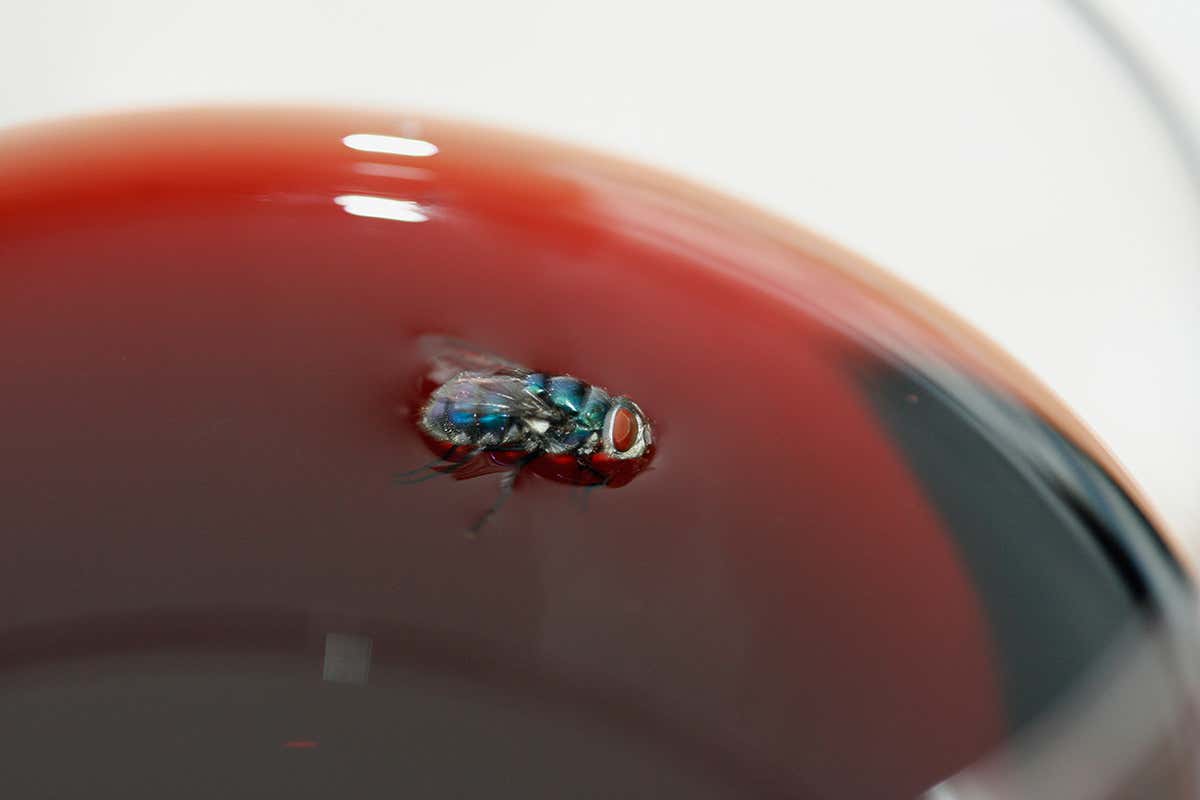
A single fly falling into your glass of wine may be enough to ruin it. We’re able to sense tiny quantities of a pheromone released by female fruit flies, and just one nanogram is enough to give a drink an unpleasant smell and taste.
Drosophila melanogaster females produce a pheromone to attract males, releasing about 2.4 nanograms of the chemical an hour. When Peter Witzgall and Paul Becher at the Swedish University of Agricultural Sciences, in Uppsala, first identified and isolated this pheromone, they wondered if it explained an anecdote they’d heard about a fly flying into a glass of wine and changing how it tastes.
To find out, the team enlisted the help of a panel of eight experienced wine tasters from the Baden wine region in Germany.
Advertisement
Funky taste
They asked the tasters to examine various glasses of wine. Some of these glasses had previously contained a female fly for five minutes, while others had contained a male fly, and some had had no contact with flies at all. The experts all rated the glasses that had had female flies in them as having a stronger and more intense smell than the others.
The panel were then given glasses of water and of pinot blanc wine, some of which had previously had a female fly in them. Some other glasses had trace amounts of a synthetic version of the female pheromone dissolved in them.
The wine experts said that 10 nanograms of the synthetic pheromone mimicked the funky taste of a female fly. But even as little as 1 nanogram of the pheromone was enough for the panel to describe the taste of the wine as “somewhat unpleasant”.
This suggests that even if a fly is removed from a glass quickly, it may already have spoiled the wine. If you leave the fly to drown instead, it can still stink out the glass, because females have a pheromone precursor chemical on the waxy surface of their bodies.
Lingering smell
“Putting a few nanograms of the synthesized pheromone into the glass resulted in the same off-flavour as when a fly walked over the glass,” says Becher. “The compound is not only detectable in tiny amounts, it’s also hard to wash off, which means that the smell might even stick to glass after dishwashing.”
Strictly speaking, humans can only smell, not taste, the pheromone. But our perception of taste is heavily reliant on our sense of smell, meaning that the presence of the fly pheromone is enough to tarnish both the odour and flavour of a drink.
But it is unclear why we have evolved the ability to smell the fly pheromone. “We think it interesting that both flies and humans are highly sensitive to the same compound,” says Becher.
Reference: doi.org/10.1101/206375
Read more: Au revoir, terroir? The science of what makes great wines tick; Why adding a drop of water can make whisky taste even better
Topics: