Artwork of the collision that gave rise to the moon MARK GARLICK/SCIENCE PHOTO LIBRARY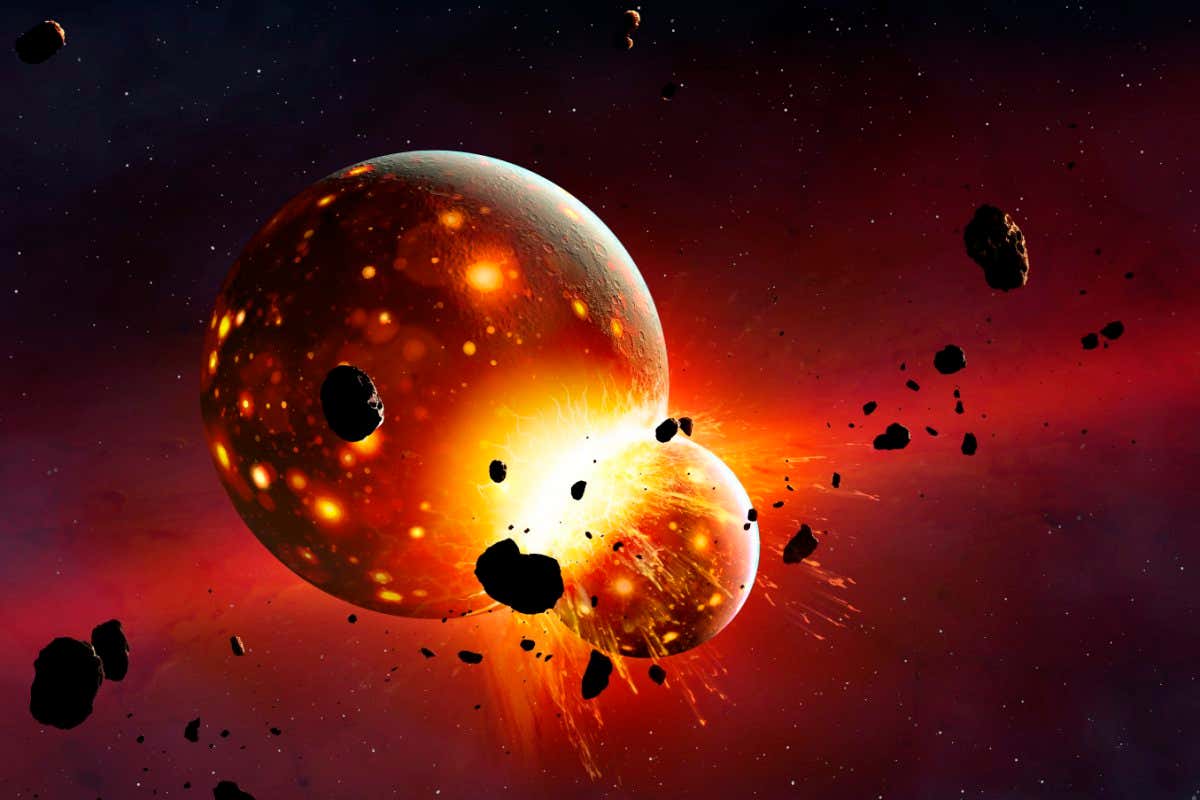
A computer simulation that traces the moon’s formation in high resolution may explain the mystery of why it is so chemically similar to Earth.
The conventional story for the moon’s origin is that a primordial planet named Theia smashed into Earth and spewed molten rock into space. This debris, primarily made up of Theia, then coalesced into the moon over tens of millions of years.
While this scenario accounts the moon’s observed angular momentum, it fails to explain the near-identical profile of the…
Article amended on 16 March 2022
We clarified how many particles the model simulated.
![Small dome in the Compton-Belkovich region (61.33 ?N, 99.68 ?E). Evidence indicates a volcanic origin for this and other intriguing features in the region. Incidence angle is 64?, Sun is from the SSW, image is ~510 m across. NAC image number M139238146L [NASA/GSFC/Arizona State University].](https://images.newscientistbeta.com/wp-content/uploads/2023/07/07172644/SEI_163208069.jpg)