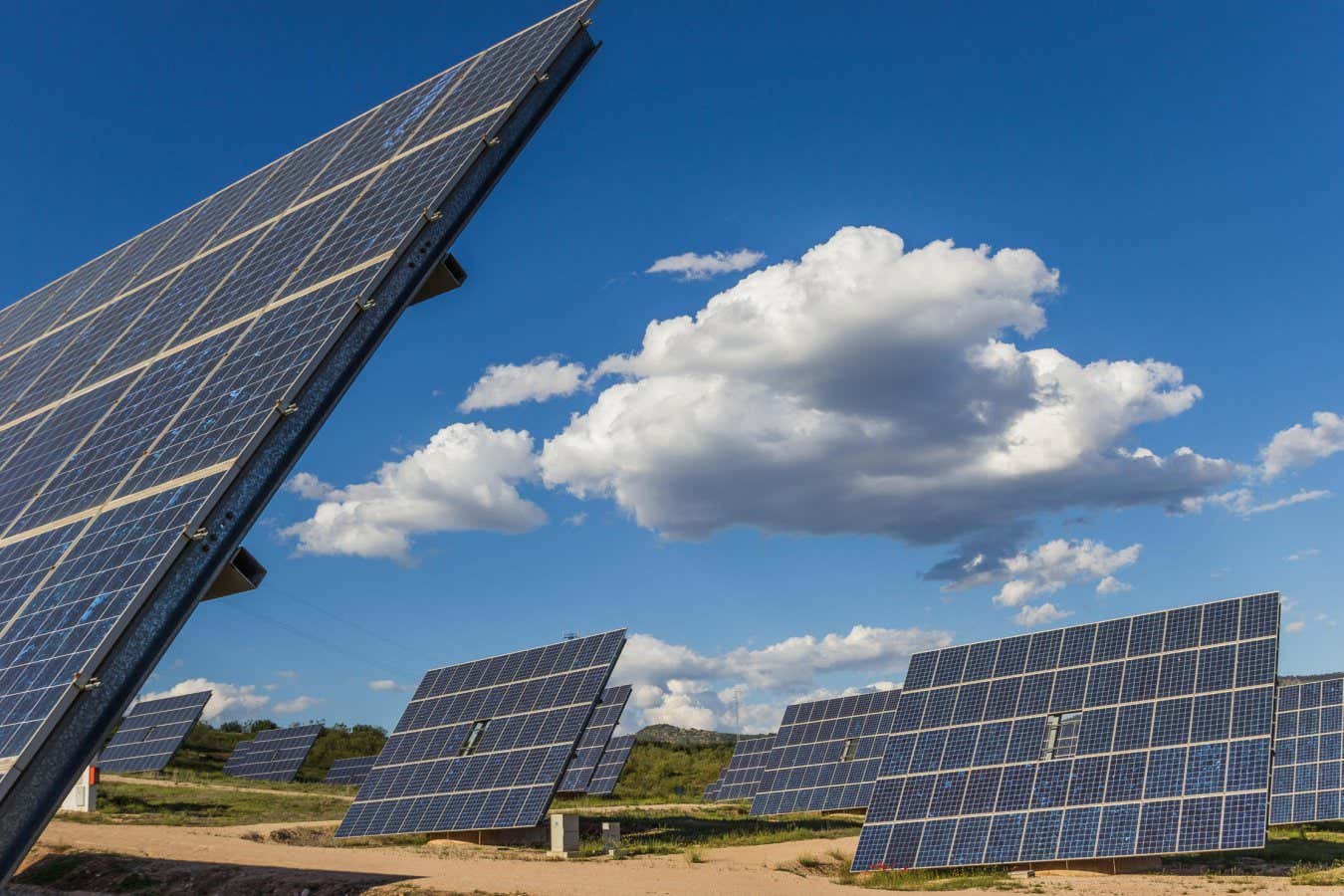
A solar power plant at night Shutterstock / Koucyk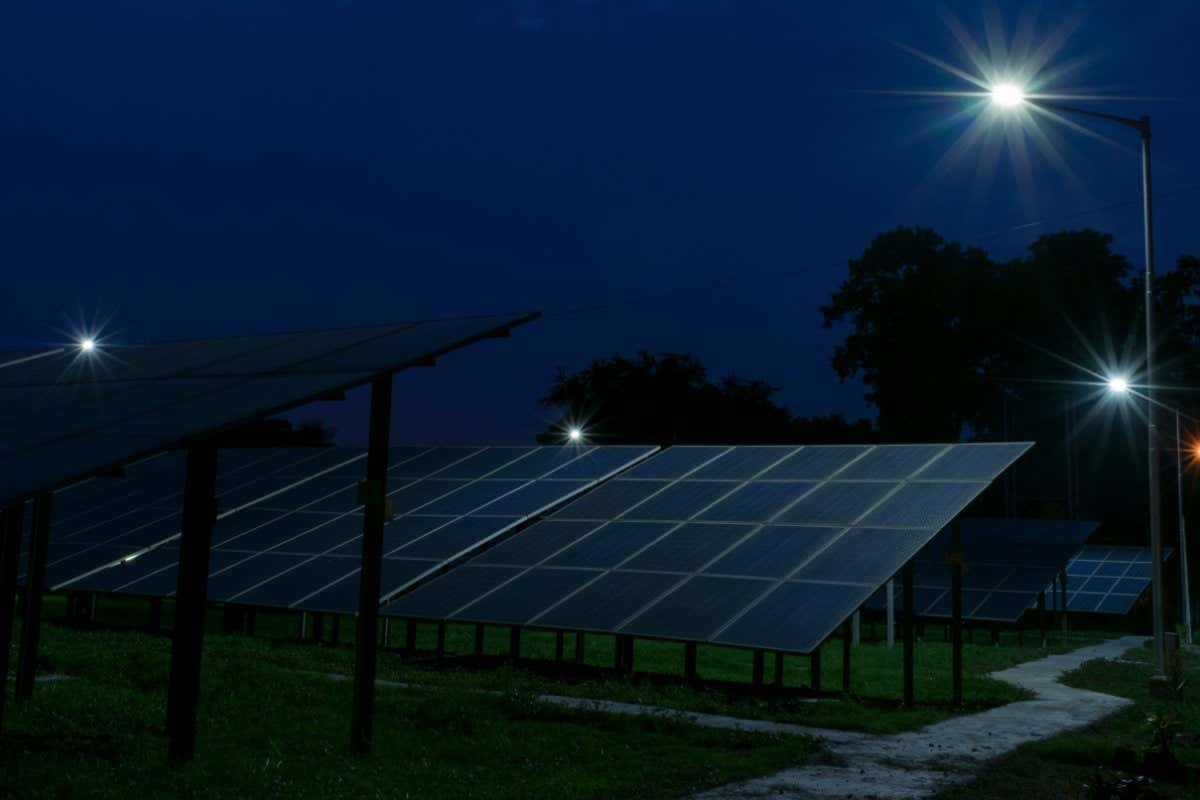
Modified solar panels that work at night generate enough power to charge a phone or run an LED light, bypassing the need to store energy in batteries in off-grid locations.
In simple terms, solar electricity is generated when the sun radiates energy towards a relatively cool solar panel. The panel consists of so-called solar cells, made from layers of a semi-conducting material, usually silicon. When light shines on this material, it generates a flow of electricity.
At night, however, solar panels radiate heat to outer space, which has a temperature of around 3 kelvin (-270.15°C), because heat travels in the direction of lower temperatures. This makes the solar panel cooler than the night air, a temperature difference that can be exploited to produce electricity.
Advertisement
To do this, Shanhui Fan at Stanford University in California and his colleagues modified an off-the-shelf solar cell by adding a thermoelectric generator, a device that produces currents from temperature differences.
“The solar panel turned out to be a very efficient thermal radiator,” says Fan. “So, at night, the solar panel can actually reach a temperature that’s below the ambient air temperature, and that’s a rather unusual opportunity for power harvesting.”
When pointed at a clear night sky, the modified solar cell generated a power output of 50 milliwatts per square metre. This is just 0.04 per cent of the power output of a regular solar cell during the daytime. But 50 milliwatts per square metre would enable low-power devices, such as a phone charger or a low-wattage LED light, to function.
“The nice aspect about this approach is that you essentially have a direct power source at night that does not require any battery storage,” says Fan. Batteries can be expensive and temperamental. They also require a lot of energy to manufacture, and can contribute to water and air pollution if improperly disposed of.
While the night-time solar cells could be useful in off-grid locations for certain low-power tasks, their current performance means they are unlikely to replace existing energy infrastructure. “The potential for large-scale power generation is therefore very low,” says Ken Durose at the University of Liverpool, UK.
Fan and his team say the set-up could be improved to generate more power and there are no intrinsic difficulties in one day scaling the system up to a commercial product.
Applied Physics Letters DOI: 10.1063/5.0085205
Topics: