An illustration of the exoplanet TRAPPIST-1f, which appears to be tidally locked NASA/JPL-Caltech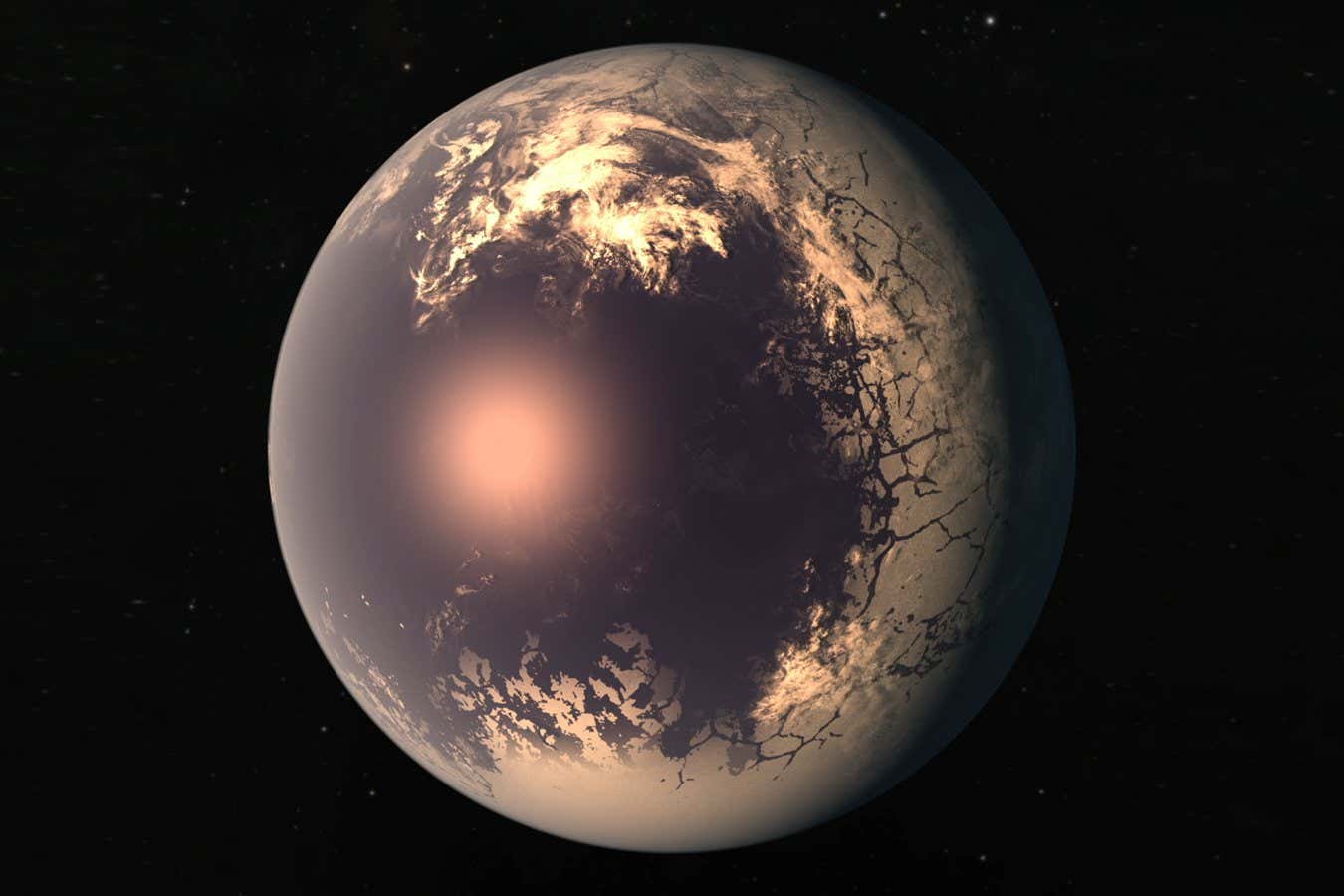
Some alien planets thought to be locked in place around their parent star may actually be able to rotate, creating stable climates long enough for potential life to arise – as long as any inhabitants didn’t mind sudden disruption.
Many exoplanets that closely orbit red dwarf stars, such as in the TRAPPIST-1 system, are thought to be tidally locked by their star’s gravity, so the planets have permanent day and night sides that are extremely hot or cold. It has previously been thought that life could…
Article amended on 17 April 2023
We have corrected the type of star in the TRAPPIST-1 system

![Nature Astronomy, doi:10.1038/s41550-022-01634-x Fig. 4 | SCExAO/CHARIS images of AB Aur at different wavelengths and observing modes. Left: polarized intensity wavelength-collapsed image obtained one day later. A pure scattered-light disk feature would have been detected at the position of AB Aur b (green circle). Instead this region shows no concentrated emission, indicating that AB Aur b is not detected. Right: emission at the approximate position of AB Aur b from VAMPIRES H? data using RDI/KLIP for PSF subtraction. From left to right, the intensity scaling is [0, 0.0925] mJy, [0, 0.055] mJy and [?0.007, 0.007] mJy, normalized to the source?s apparent FWHM. The x and y axes are in units of arcseconds east (along the x axis) and north (along the y axis).](https://images.newscientistbeta.com/wp-content/uploads/2022/04/04144318/SEI_97110504.jpg)
