A male skywalker gibbon Pengfei Fan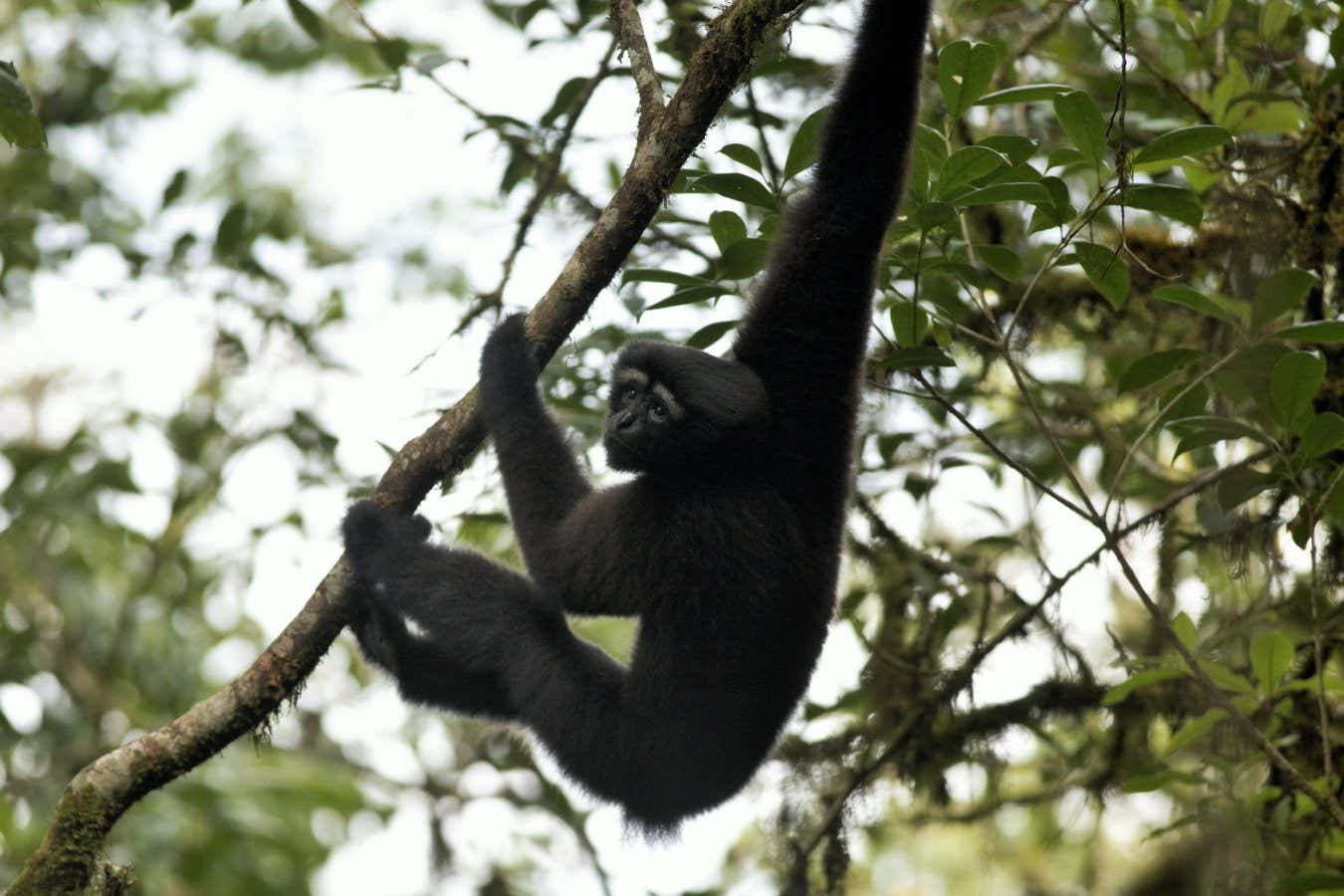
Gibbons get up early when they want fruit for breakfast, showing a capacity for planning that has rarely been documented in wild animals.
Skywalker gibbons (Hoolock tianxing) forage over a range of 1 to 3 square kilometres, feeding on a variety of fruits and leaves.
Pengfei Fan at Sun Yat-sen University in Guangzhou, China, and his colleagues studied two groups of skywalker gibbons in the Gaoligongshan National Nature Reserve in south-west China for around five years. They followed gibbons from the trees where they slept to those where they foraged in the morning, recording the times when they set off and arrived.
Advertisement
On average, the gibbons travelled 130 metres to trees where they ate fruit and 100 metres to trees where they ate leaves. When heading out to feed on fruit, the two groups left their sleeping trees between half an hour and an hour earlier compared with when they were feeding on leaves, and arrived at their destinations earlier.
Fruit trees are less abundant and the gibbons face competition from many other animals for the fruit, says Fan, so it pays for them to get there earlier.
The gibbons travelled more quickly when heading for trees that were further away, suggesting they remembered the locations of trees bearing their favourite fruits and leaves.
“I think this study is particularly important because the way in which animals navigate their environment to reach food sources can be a key indicator of planning and intelligence, which is, of course, reflected most often in humans,” says Edward McLester at the Max Planck Institute of Animal Behaviour in Konstanz, Germany. The findings suggest that skywalker gibbons plan their travel routes to reach their preferred locations early, rather than stopping arbitrarily at the first source of food they encounter, he adds.
Some other factors also influenced the time when gibbons headed out for breakfast. When it rained or the temperature was cooler the night before, the gibbons delayed their departure the next morning. Sleeping in a larger group also meant they set off later, as it made it more difficult to reach a consensus about where to go.
“Gibbons need to balance the need to reach calorie-rich fruit before other competing animals against the risks of hunting by leopards or humans, falling from trees in the dark and recovering from exposure to cold and rain during the night,” says McLester.
Journal reference:
Proceedings of the Royal Society B: Biological Sciences DOI: 10.1098/rspb.2023.0430
Topics: