The experimental supersonic aircraft XB-1 Boom Supersonic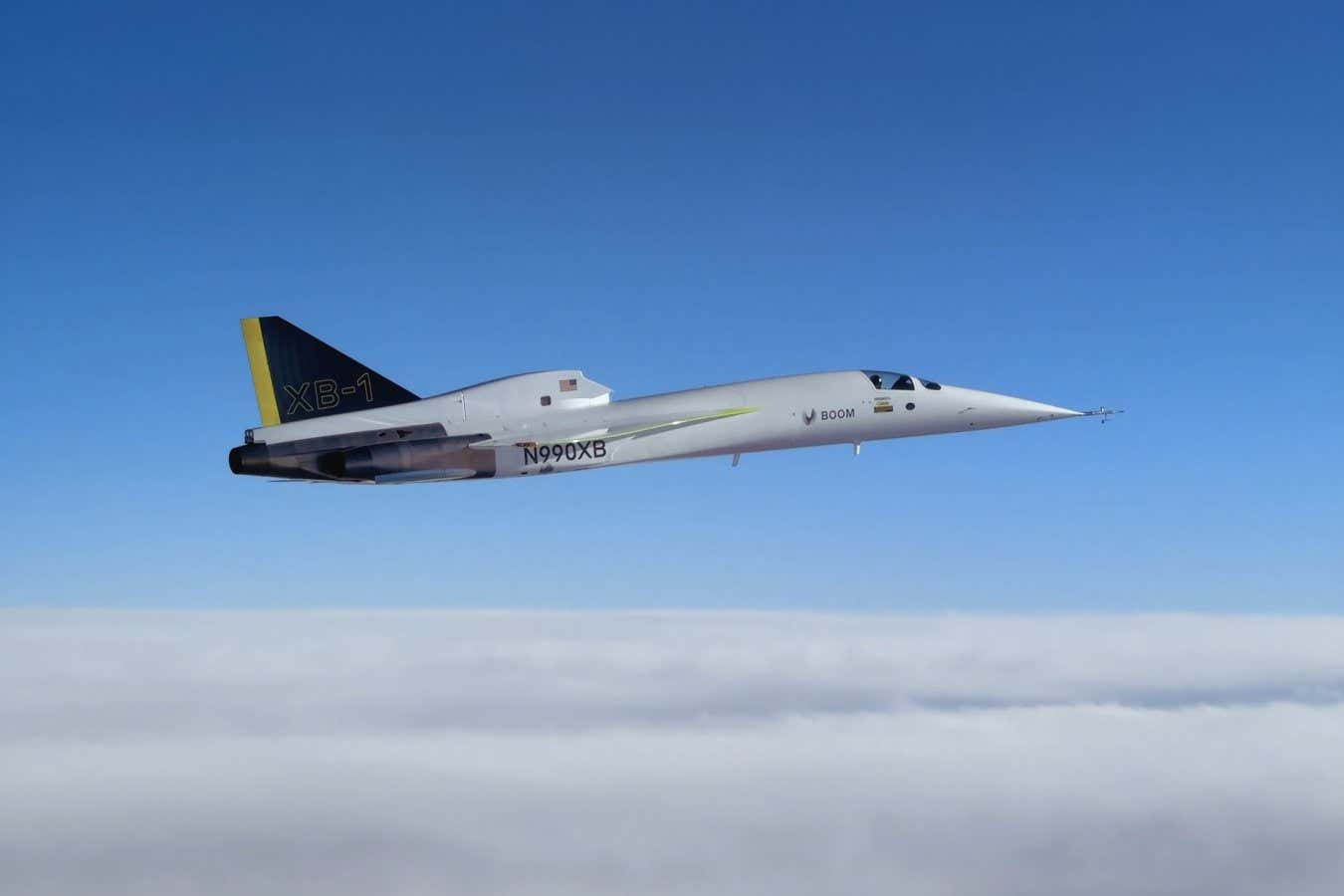
When the experimental XB-1 aircraft broke the sound barrier three times during its first supersonic flight on 28 January, it did not produce a sonic boom audible from the ground, according to US company Boom Supersonic.
“This confirms what we’ve long believed: supersonic travel can be affordable, sustainable and friendly to those onboard and on the ground,” said Blake Scholl, founder and CEO of Boom Supersonic, in a press release.
Advertisement
As an aircraft pushes through the atmosphere at a high speed, it changes the air pressure around it, creating sound waves. And when a supersonic flight surpasses the speed of sound – Mach 1 – these sound waves combine to form a shock wave that spreads away from the flight path. This sonic boom can travel far enough to reach the ground, where it can produce an extremely loud noise, rattle buildings and even break glass.
Sonic booms over land are so disruptive that they contributed to the retirement of the fabled commercial airliner Concorde in 2003 and spurred many countries to prohibit commercial supersonic aircraft. Since then, aerospace engineers have been trying to develop aircraft designs that can go supersonic without the accompanying boom.
Free newsletter
Sign up to The Weekly
Receive a weekly dose of discovery in your inbox.
In this case, the XB-1 took advantage of a physics phenomenon called the Mach cutoff. Because sound moves more slowly at higher altitudes, an aircraft breaching the sound barrier at those heights will produce a boom that cannot reach the ground – if the boom moves downward, the increasing speed of sound will deflect it, pushing its shock waves upward instead.
The trick is that temperature and wind also affect sound speeds, so the ideal altitude and speed for a supersonic aircraft will depend on atmospheric conditions. “The actual challenge is getting very accurate atmospheric forecasts on temperature and on wind – computing the practical Mach-cutoff flight speed is pretty straightforward from there,” says Bernd Liebhardt at the German Aerospace Center.
Boom Supersonic says that XB-1’s most recent and final test flight, on 10 February, also reached supersonic speeds without producing a boom. Now the company is using what it learned from the test flights to help its future commercial airliner, Overture, achieve the same feat. Supersonic overland flights would be up to 50 per cent faster than today’s commercial airliners. That could shorten the air travel time from New York to Los Angeles by 90 minutes.
But performing the Mach-cutoff flight “burns more fuel on the same distance than both subsonic and supersonic flight”, says Liebhardt. That makes it less economically viable than a regular supersonic flight and “the worst speed to fly at for fuel economy”. He sees Mach-cutoff flights as being more of a niche use case for “supersonic business jet users”, rather than for commercial airlines.
Topics: