The dwarf galaxy M32 probably crashed into the heart of Andromeda 210 million years ago, setting off shock waves that created two dusty rings, marked in blue and green (Image: NASA/JPL/P. Barmby/CfA)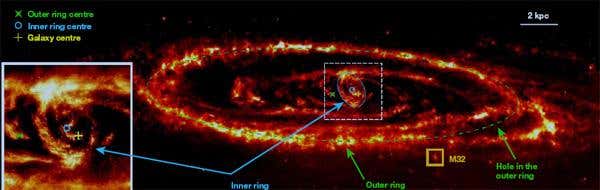
A two-decade-long riddle about the bizarre shape of the Milky Way’s nearest spiral-shaped galaxy, Andromeda, has been solved, suggests a new study.
Instead of having the flat plane and outflung arms that are the hallmarks of a mature spiral galaxy, Andromeda has a warped plane and several rather chaotic, overlapping outer rings.
The reason, according to an international team of astronomers, is that Andromeda suffered a head-on collision with a smaller galaxy some 210 million years ago.
Advertisement
The evidence comes from infrared images of Andromeda taken by NASA’s orbiting Spitzer Space Telescope. They show a previously hidden, tilted second ring that protrudes from the heart of the galaxy. This ring is likely to be the shockwave of gas and dust from a colossal collision.
The theory has been put to the test in a computer simulation. It suggests a dwarf galaxy called M32 probably drove straight into the heart of Andromeda, which is also known as M31.
“While head-on collisions may have been common in the early universe, only a handful are known nearby,” says the paper, whose lead author is David Block of the University of Witwatersrand in South Africa. “The discovery of one in our near-neighbour M31 affords the unique opportunity of studying such a collision at unprecedented spatial resolution.”
Andromeda, first spotted as “a little cloud” by the Persian astronomer Abd-al-Rahman Al Sufi in 964, is itself headed for a collision with the Milky Way. However, the two galaxies are more than 2 million light years apart and the collision will probably take place between 3 billion and 6 billion years from now.
Journal reference: Nature (vol 443, p 832)