The four HESS telescopes in Namibia found two of the new types of object (Image: HESS team)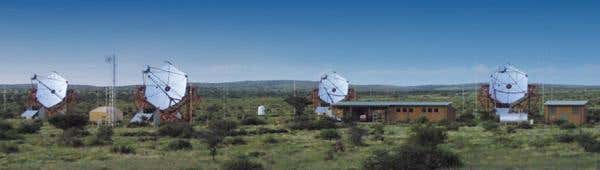
Three new types of object have been discovered in our galaxy: huge gamma-ray clouds, dense X-ray engines almost hidden in cocoons of dust, and bubbles blown by the wind from giant stars.
All three discoveries were reported on Monday at a conference at Stanford University in California, US.
Two come courtesy of the High Energy Stereoscopic System (HESS), an array of four telescopes in Namibia that detects photons of extremely high energy. When one of these gamma rays hits the atmosphere, it produces a flash of blue light that HESS can pick up.
Advertisement
HESS has seen such gamma rays coming from Westerlund 2, a cluster of massive, bright stars about 25,000 light years away. The emission is too diffuse to be coming directly from the stars. “The gamma-ray source is much larger than the cluster itself,” says team member Olaf Reimer of Stanford.
Instead, he thinks the emission is generated by winds from several massive stars within the cluster. Called Wolf-Rayet stars, they are so bright their light blasts gas off of them and out into space. The total energy in this stellar wind over the course of each star’s brief life is similar to that of a supernova explosion.
Particle accelerator
“The solar wind [from our Sun] is a gentle breeze compared with these things,” says Luke Drury, a theoretician from the Dublin Institute for Advanced Studies in Ireland.
As the winds slam into interstellar gas around the cluster, they create shockwaves that boost electrons and protons up to high energies, says Reimer. In turn, those charged particles emit the gamma-rays seen by HESS.
If so, some of the protons must leak away from the cluster, becoming high-speed, free-roaming cosmic rays like the ones that constantly hit Earth. Drury estimates that such giant-star-powered bubbles could produce up to 20% of the galaxy’s cosmic rays.
Reimer is more cautious, pointing out that this cluster holds an exceptional object: the binary star WR 20a. “This is the most massive binary we know of in the galaxy,” Reimer told New Scientist. Such super-Wolf-Rayets may be the only objects powerful enough to generate so much gamma and cosmic radiation.
Tenuous breeze
HESS has also spotted 12 huge gamma-ray clouds. Each one surrounds a dense stellar corpse called a pulsar just 10 kilometres or so wide. These clouds are probably also wind-blown, although the wind is only a tenuous breeze of electrons spreading out from each pulsar.
These electrons will occasionally bump into ordinary low-energy photons, boosting their energy into the gamma-ray band, the team believes.
The clouds are surprisingly big – one is 100 light years across. “If we could see it with our eyes, this nebula would have a diameter twice that of the Moon,” says team member Arache Djannati-Ataï of the Astroparticle and Cosmology Laboratory in Paris, France.
Odd couple
A more mysterious kind of object has been revealed by Europe’s orbiting gamma-ray observatory INTEGRAL. It has spotted 20 new sources involving another kind of stellar corpse, a neutron star that glows in X-rays as it eats gas from a neighbouring giant star.
Curiously, although these new sources are unusually faint, they emit an unexpectedly large amount of infrared radiation, says Sylvain Chaty of the University of Paris in France.
They think a cloud of hot dust, which surrounds both the giant star and the neutron star, blocks most of the neutron star’s X-rays but glows at infrared wavelengths (watch an animation of the process).
All these odd dust-shrouded objects are in one area – the Norma arm of the galaxy, close to the galactic centre. “We don’t know why,” Chaty told New Scientist. “There might be something different in this region of the galaxy – some different types of star.”


