The carbon fibre robotic ankle takes over the job of flexing the wearer’s foot backwards when they walk (Image: Elsevier/University of Michigan)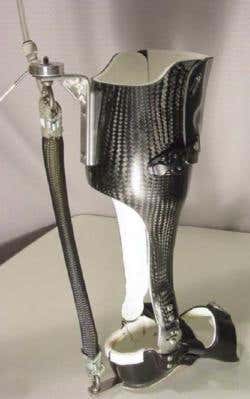
Patients with neuromuscular problems and spinal injuries could benefit from using robotic joints, suggests a study involving healthy volunteers fitted with a power-enhancing mechanical ankle.
Within half an hour, the volunteers adapted to using the ankle and learnt to walk normally. This suggests that other types of artificial joint or even full-body exoskeletons could eventually be a powerful tool for rehabilitation and therapy.
The robotic ankle was developed by Keith Gordon and Daniel Ferris at the University of Michigan, US. It is made from carbon fibre and has a pneumatic artificial muscle (see Power dressing) positioned behind the calf so that it can flex the foot downwards. The researchers are using the ankle to test how easily people can adapt to using such muscular aids.
Advertisement
The artificial muscle performs the same role as the soleus muscle that runs from just below the knee to the heel. Nerve signals sent to the soleus are picked up by electrodes attached to the user’s skin and this activates the artificial muscle. During walking the robotic ankle can perform about 70% of the work normally performed by the real muscle.
Human side
“There are teams around the world working on more impressively engineered exoskeletons than this,” Ferris told New Scientist (see Bionic suit offers wearer super-strength). “But very little time is being devoted to looking at the human side.”
Ten healthy volunteers – five female and five male – walked with the ankle muscle deactivated for 10 minutes, before walking with it switched on for another 30 minutes. Video footage, information from the artificial muscle and the electrodes were used to monitor their performance.
Initially, after activating the muscle, walking was difficult because of the extra power provided, as this video shows (7.1 MB, mpg format). “But people actually learn very quickly,” says Ferris.
Subjects had mastered their new powers by the end of the 30 minute session. “It seems that as long as you put the nervous system in control, it’s not too difficult to adapt,” he adds. A second video shows the same subject using the ankle later on (6.6 MB).
Participants were also able to instantly readapt to using the ankle after a three day break, suggesting that a person’s nervous system remembers how to deal with the extra power.
Therapeutic uses
“We are now testing on people with spinal injuries who usually spend most of their time in a wheelchair because they are unable to use some muscles and have problems coordinating them,” says Ferris. If these people can also adapt quickly to using robotic joints, they could prove useful for rehabilitation. “Results are promising,” says Ferris, who expects the research to be published later this year.
“More research is certainly needed into how people react to using them,” says David Bradley who works on exoskeletons for physiotherapy at University of Abertay in Dundee, UK, “and also into how we can make them more acceptable to patients and therapists.”
Bradley, with colleague Camillo Acosta-Marquez, has developed a therapy device – called NeXOS – that mimics the leg manipulations normally performed by a physiotherapist. A real therapist can “record” these movements by performing them on the patient while NeXOS is attached, or even combine different pre-programmed treatments.
“A lot of the best exoskeletons like this in development take up a whole room and require six or seven professionals to operate,” says Bradley. NeXOS is designed to be used in a patient’s home, a gym, or a “super-clinic” where a single therapist can supervise many patients using the machines.


