This Delta II rocket will carry NASA’s five THEMIS satellites into orbit to study what triggers auroras (Illustration: NASA)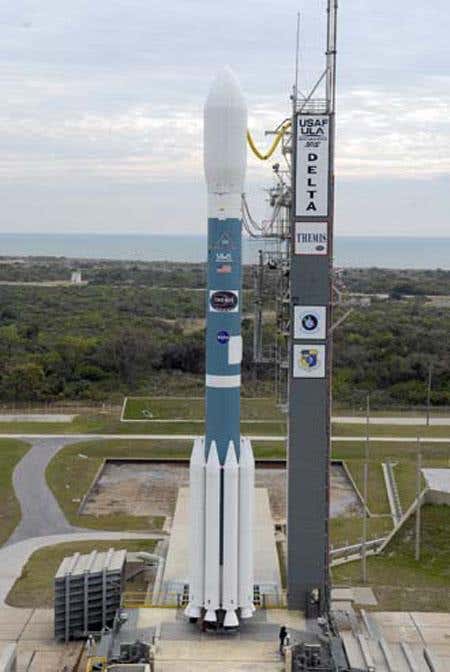
The launch of five satellites designed to determine what triggers magnetic ‘substorms’ on Earth was cancelled on Friday due to strong winds in the upper atmosphere. Lift-off will be reattempted on Saturday.
The satellites – which comprise a mission called THEMIS (Time History of Events and Macroscale Interactions during Substorms) – were originally due to launch aboard a Delta II rocket from Cape Canaveral, Florida, US, on Thursday. But lightning in the region postponed the launch by a day, to Friday.
Then, just minutes before the rocket was due to take off, launch managers called off that attempt due to unacceptably strong winds in the upper atmosphere.
Advertisement
Lift-off will be reattempted on Saturday in an 18-minute launch window that begins at 1801 EST (2301 GMT). As of Friday evening, the forecast shows just a 10% chance of bad weather for launch on Saturday.
THEMIS will study substorms – periods of rapid change in the region around the Earth dominated by the planet’s magnetic field, called the magnetosphere. They are associated with the sudden brightening of light displays in the sky called auroras.
Rapid succession
Isolated substorms can happen during periods of relatively little solar activity, and are not dangerous. But when the Sun has an outburst that sends clouds of charged particles streaming towards Earth, a series of 10 or more substorms can occur in rapid succession. This barrage may be responsible for the failure of power grids and satellites observed during some of the events.
There are two competing ideas for what triggers substorms. One says they happen when solar activity compresses the magnetic field lines around Earth, causing large electrical currents to flow in the tenuous gas of charged particles in the magnetosphere.
The other hypothesis is that substorms happen when magnetic field lines compress and suddenly relax in events called magnetic reconnections, which accelerate charged particles towards the Earth.
Understanding what triggers substorms could help scientists predict which solar outbursts are hazardous and which will leave the Earth and its vicinity relatively unscathed.
Two of the five probes will orbit the Earth at one-sixth of the distance to the Moon while the other two will orbit about midway between the Earth and the Moon. The fifth one is a spare that can be used to replace any of the four others.
Watch an animation showing the launch and deployment of the THEMIS satellites.