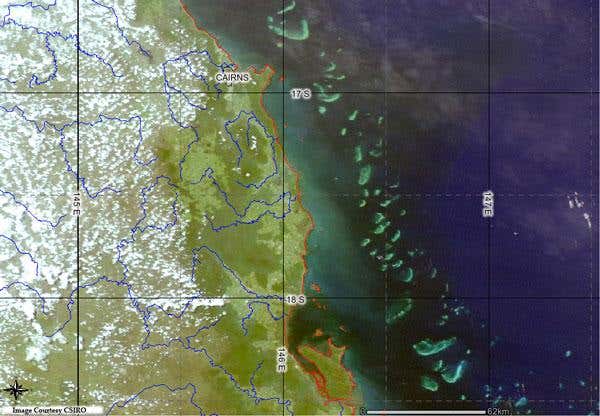
Sediment, brown and green against the blues that show ‘normal’ reef waters, from rivers (Image: CSIRO/GeoScience Australia) This image shows how the sediment plumes have travelled further, beyond the reef into the ocean, but have started to disperse (Image: CSIRO/GeoScience Australia)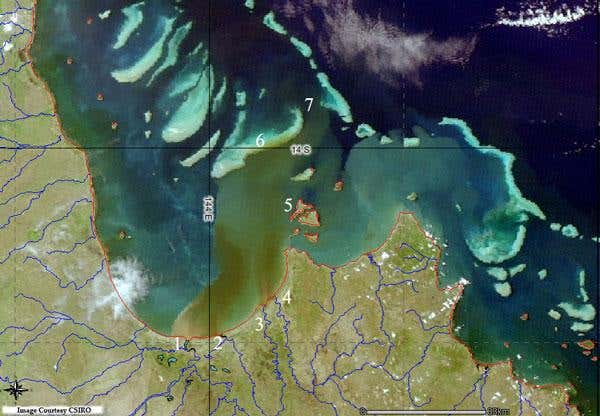
Agricultural chemicals and pesticides could be threatening the outer reaches of Australia’s Great Barrier Reef, new satellite pictures reveal.
The graphic images show that heavy rains can send plumes of freshwater and sediment racing from the land to the outer limits of the reef. Not only does this river water travel much further than had been expected, but the speed and direction of the flow does not necessarily match that predicted by models.
The team at CSIRO Land and Water in Canberra used images taken by NASA’s MODIS satellite from 9 to 13 February 2007. This followed a period of exceptionally heavy rain in northern Queensland, which lasted from late January to early February.
Advertisement
Models suggested that outflow from the rivers would travel north along the coast and slowly, in weeks or months, diffuse into the Great Barrier Reef lagoon. But the images, which were taken twice a day with a resolution of 250 metres per pixel, show plumes travelling at speeds of up to 1 kilometre per hour as far as 130 kilometres off the coast (see image, lower right). Though much of the flood run-off did travel north, some also headed east.
“We were able to demonstrate that the river plumes actually behave quite differently than many people had thought up until now,” says Arthur Dekker, who led the study. “Some stakeholders on the land have tried to argue that run-off stays close to the coast. But these images show otherwise.”
The precise impact of river run-off on coral and other reef organisms is still being investigated. But earlier studies have found high levels of herbicides, pesticides and other contaminants, along with soil, in water running off the Queensland coast.


