The ridge on Iapetus remains almost exactly parallel to the equator to within a couple of degrees (Image: NASA/JPL/Space Science Institute)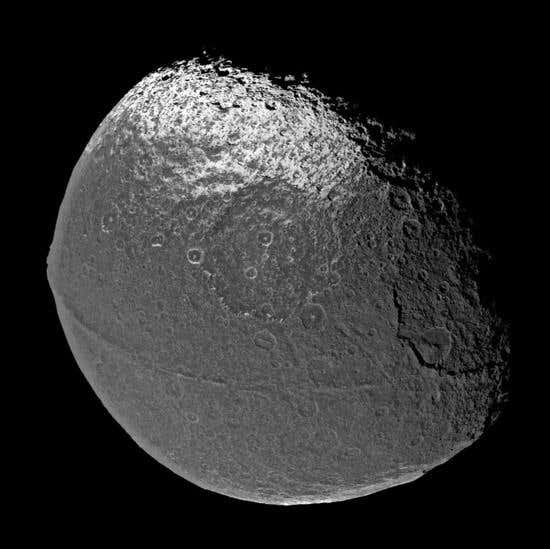
A burst of radioactivity warmed and softened Saturn’s moon Iapetus soon after it formed, allowing it to be moulded into its walnut-like shape, a new study says.
Iapetus has a broad bulge around its equator capped by a narrow ridge, giving it the appearance of a walnut. Scientists have been puzzling over how it acquired its distinctive shape since the ridge was discovered in 2004 in images from the Cassini spacecraft.
One hypothesis by a team led by Julie Castillo of NASA’s Jet Propulsion Laboratory in Pasadena, California, US, is that the moon was warmer and more malleable in its early days. If it also spun more quickly back then than it does now, it would have bulged out at its equator as a result.
Advertisement
When the moon’s rotation later slowed, it would have become more spherical in shape. But by that time, it was colder and stiffer – too rigid to mould itself into a smooth shape. As a result, the team says, the process left behind a distinctive ridge of material at the equator (see New attempts to crack Saturn’s walnut moon).
Now, Castillo’s team has published a detailed study based on their hypothesis, with a short burst of radioactivity providing the crucial ingredient of early heat needed to make it all work.
“Iapetus spun fast, froze young, and left behind a body with lasting curves,” says Castillo.
Narrow window
According to their scenario, Iapetus was born with an abundance of radioactive material in the form of isotopes like aluminium-26 and iron-60. These materials – which may have been injected into the embryonic solar system by a nearby supernova – quickly break down into other elements, and their rapid decay could have provided a burst of heat to soften Iapetus soon after it formed.
In order to get enough heat from this process to explain its early softening, Iapetus would have had to have formed during a narrow window in the solar system’s early history, when these short-lived radioactive materials are thought to have been abundant.
Based on this reasoning, Castillo’s team has dated the formation of Iapetus to a 2.5 million-year period between about 4.565 and 4.562 billion years ago.
David Stevenson of Caltech in Pasadena, US, who is not a member of the team, says the model can explain the broad bulge at Iapetus’s equator. But he says it does not adequately account for what caused the narrow ridge there.
He says Saturn took millions of years to form and suspects Iapetus coalesced after Saturn did. If so, that might have been too late to benefit from heating due to radioactive materials with a short half-life, such as aluminium-26. “I am not saying their model is wrong – it might be right,” he told New Scientist. “I am simply saying that it is a lot to swallow.”
Another hypothesis says the ridge formed when material from a ring orbiting the moon collapsed onto the surface.
Cassini: Mission to Saturn – Learn more in our continually updated special report.
Journal reference: Icarus (DOI:10.1016/j.icarus.2007.02.018)
Topics: