The Hubble Space Telescope has captured a close-up of the expanding remnants of a supernova observed in 1006 CE (Image: NASA/ESA/Hubble Heritage Team)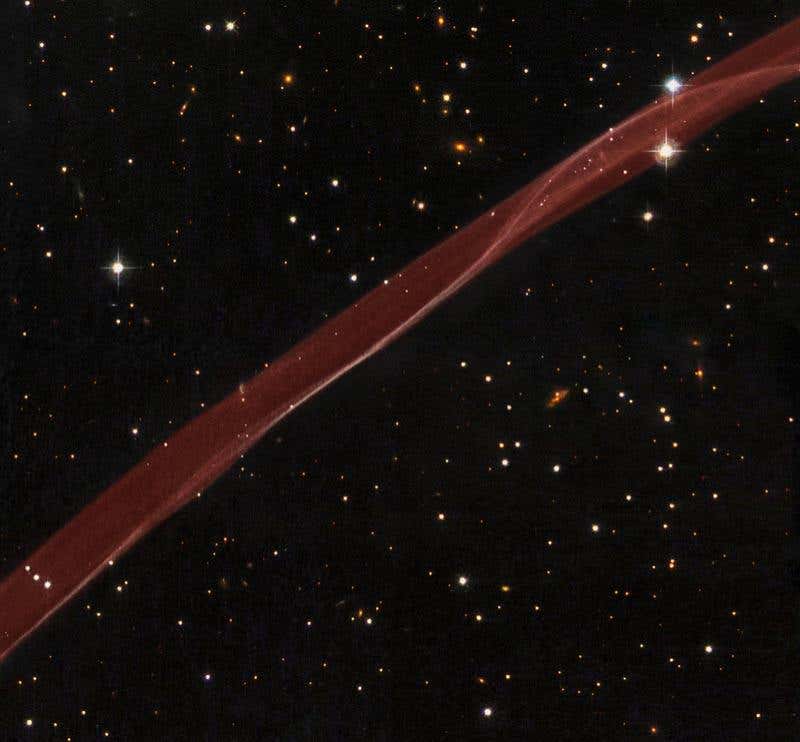
Medieval skywatchers got to see a star explode, but modern-day astronomy buffs get all the pretty pictures of its ghostly remains.
Hubble has captured a close-up of the remnant of a supernova that exploded in the Milky Way over 8000 years ago, and whose light reached Earth on 1 May 1006. The explosion is one of the brightest in recorded history and was visible with the naked eye.
The delicate-looking remnant is actually part of a shock wave from the stellar explosion. The roiling remains are still expanding, moving at a clip of about 10 million kilometres per hour.
Advertisement
Hubble’s image is mostly a composite made from the visible light emitted by hydrogen atoms in the remnant.
Bright parts of the twisting ribbon are places where the shock wave from the explosion lies edge-on with our line of sight.
The remains of the supernova are faint in visible light, but astronomers have produced stunning images in the X-ray part of the spectrum.
View a gallery of other shimmering supernova remnants (move your mouse over the images to read the captions).


