Caption: Floating tiny samples across a digital camera sensor provides a cheap way to do microscopy, that will fit into a pocket-size gadget (Image: Changhuei Yang)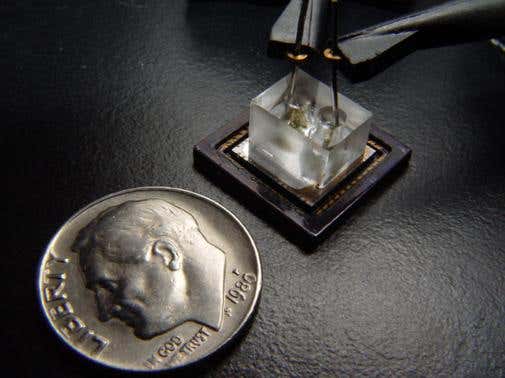
Optical microscopes used to be bulky instruments. The lenses and lights normally needed to illuminate, magnify and focus an image take up a lot of space, and are fragile and expensive to boot.
Not any more. Researchers have squeezed a powerful microscope onto a single image-sensing chip and removed the need for lenses.
The cheap, portable device could be just what medics in the developing world need to diagnose diseases such as malaria, its inventors suggest.
Advertisement
Pocket microscope
“Because the image processing that’s needed is trivial in computing terms, we could build the microscope into an iPod-sized device with an LCD display, says Changhuei Yang of the California Institute of Technology in Pasadena.
“The $10 chip would be a disposable, like an inkjet cartridge, and the whole thing would fit into a clinicians’ back pocket,” he says, adding that a disposable sensor would reduce the risk of contamination between samples.
Chip-based microscopes are not a new idea. If a sample is placed directly on top of a “CCD” image-sensing chip, like those used in digital cameras, the chip will produce a rough image of it.
Yang was inspired to try and develop a microscope using CCD technology by the phenomenon of “floaters”, in the human eye, small pieces of debris that are seen when they cast a shadow on the retina.
Snapshot sampling
Yet since the pixels in commercial CCDs are usually at least 3 micrometres across, they cannot compete with the sub-micrometre resolutions achievable by optical microscopes.
To boost the resolution of a CCD microscope, Yang and his colleagues coated the CCD with an ultra-thin layer of aluminium and etched 1-micrometre-wide holes above each physical pixel, so only the light through these tiny apertures could be picked up. That produces a set of snapshots of parts of the sample
To complete the picture, the team puts the sample in a microfluidic chamber, where it is allowed to move under gravity or via electrical charge. This gently shifts it across the sensor surface at a predetermined rate, so every part is imaged in turn.
A computer program then compiles the final composite image. The approach allowed the team to image sub-micrometre features of algae, nematodes and pollen.
Yang is confident his device can succeed on the commercial market. “The CCD chip itself costs $10 and the microfluidic part may cost 10 cents,” he told New Scientist.
Journal reference: PNAS (DOI: 10.1073/pnas.0804612105)