Test particles left a carrot-shaped trail in aerogel when fired from a special air gun (Image: JPL)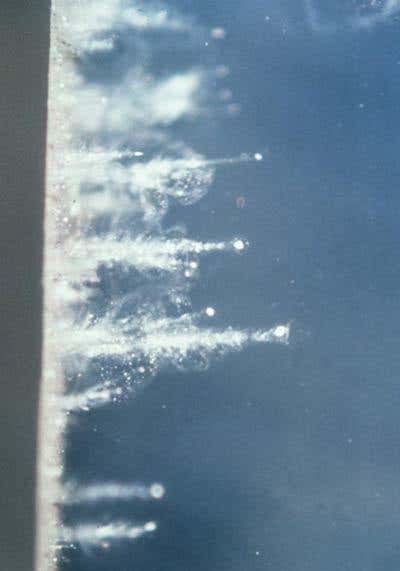
Scientists studying material collected by NASA’s Stardust mission during its seven years in space had hoped to have a speck of interstellar dust in hand by now. Unfortunately, new data show its first six candidate dust particles originated much closer to home – with most coming from Earth or the spacecraft itself.
The Stardust probe launched in 1999 and visited a comet called Wild 2, collecting space dust in a honeycomb matrix of gel. Most of the dust collected comes from the comet, but NASA scientists estimate it may have also picked up as many as 45 pieces of dust that originated outside the solar system.
Since the gel and its samples returned to Earth in 2006, the Stardust@home website has recruited an army of almost 30,000 volunteers to sift through cross-sections of the gel, looking for telltale holes – just 20 microns across – left by these dust impacts.
Advertisement
Scientists expect interstellar dust to be made of the same kind of dust that our own solar system is made of – material that was processed through many stars and blown into interstellar space. Its composition should be similar to the surface of our Sun: a mixture of mostly lighter elements but some metals like iron.
But studies of six of the candidate particles at Lawrence Berkeley National Laboratory in the US and the European Synchrotron Radiation Facility (ESRF) in France show most of the particles came from Earth.
More to come
The team blasted tiny wedges, or “keystones”, of gel containing the particles with powerful X-rays that reveal the energy signatures of metallic elements.
Three of the six candidates showed large quantities of zinc – a metal that is rare in the cosmos, suggesting the dust particles came from Earth and were ejected by the spacecraft in space. Another was high in cerium, an even rarer metal that flaked off Stardust’s solar panels in space.
The fifth candidate was a piece of alumina, or aluminium oxide, an impurity deposited when the gels were being made on Earth.
And the last candidate was “invisible” to the beam, missing the metals that the scientists would expect to see. “It would have had to be mostly light elements like hydrogen, carbon, nitrogen and oxygen,” says Andrew Westphal, director of Stardust@home. Most of the candidates left trails through the Stardust gel; this one left a crater, so the team is wondering if this is an impacting particle at all.
But the team is not discouraged. “This is not at all unexpected. We have around 100 candidates, and we’ve only looked at the first six,” Westphal told New Scientist.
Destructive techniques
He says Stardust@home volunteers are effectively finding dust tracks in the aerogel. And the team’s extraction techniques have improved, so that the 0.5-metre-long robotic arm used to cut out promising aerogel sections can do so without damaging the embedded particle. Westphal says three such keystones can now be harvested per week.
Now that the X-ray tests have been done on this first batch of particles, other research groups can apply to study them with destructive techniques, which would look for non-metallic elements such as oxygen.
In the meantime, the Stardust group will have to wait until its scheduled ESRF time in a few months to probe new candidates.
The new research was presented last week at a meeting of the Meteoritical Society in Japan.
Comets and Asteroids – Learn more in our special report.