A robotic observatory installed on Dome A in Antarctica was designed to test the site’s suitability for observing (Image: University of New South Wales)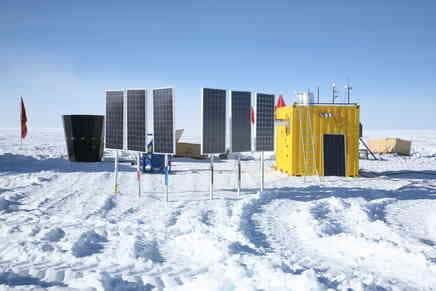
A robotic observatory designed to test the astronomical observing conditions at a remote Antarctic plateau has lost power after 204 days of operation. The project may be resuscitated with solar power in the coming weeks, when sunlight returns to the region.
Earlier this year, a Chinese expedition installed the PLATeau Observatory (PLATO) on a site called Dome A, which sits 4100 metres above sea level on the Antarctic plateau.
The observatory includes a range of telescopes and meteorological instruments designed to test the sky conditions above Dome A, which some astronomers suspect is the best place on the planet to do ground-based astronomy.
Advertisement
That’s because it boasts months of uninterrupted night during wintertime in the southern hemisphere and is at a high altitude – meaning there is less distortion-inducing atmosphere between it and its celestial targets. The site is also very dry, which is good for astronomy because atmospheric moisture absorbs certain wavelengths of light.
Diesel engines and 4000-litres of jet fuel have been used to keep the batteries for PLATO’s instruments warm and charged – important since the observatory has been operating in 24-hour-darkness for nearly the last four months. PLATO was designed to run unattended until a re-supply mission brought it more fuel and new instruments in 2009.
But late last week, the observatory’s instruments stopped working after one of the diesel engines developed an exhaust leak. The drop in power may have made the instrument batteries too cold to hold a charge.
Solar power
Still, the Sun will rise on the site in roughly two weeks, and team members hope PLATO’s solar panels will be able to kick in and restart the observatory. “Hopefully this is just a brief hiatus,” says astronomer Craig Kulesa of the University of Arizona in Tucson. “Hopefully by the time we get to September we’ll be able to pick up again where we left off on just solar power.”
The observatory was built at the University of New South Wales in Sydney, Australia, and incorporates instruments from China, the US, and the UK.
One instrument, called Pre-HEAT, is designed to measure light at sub-millimetre wavelengths. Light from this part of the spectrum could be useful to study phenomena such as star birth. Water vapour in the atmosphere usually obscures most of this light, but it may be clear in the Antarctic, where the air is too cold to hold much moisture.
Kulesa says preliminary results show 70% of one test wavelength this light can pass through the sky above Dome A. At another station at the South Pole, which lies some 1200 metres lower in altitude, only 40% of the light makes it though.
‘Extraordinary weather’
“The weather we’ve seen has been rather extraordinary,” Kulesa told New Scientist. “As far as we can tell, these are the best conditions we’ve seen on Earth.”
Although the site seems to be promising for sub-millimetre astronomy, it is not yet clear whether it will be good for optical telescopes. That’s because a turbulent layer of air hovers over the Antarctic ice that can blur stars and reduce a telescope’s power.
At the South Pole, a telescope would need to sit on a 300-metre-high platform to get above the turbulence. Another Antarctic site, Dome C, has only 30 metres of turbulent air above it. But PLATO collaborators hope the layer will be much thinner at Dome A.
The Shanghai-based Polar Research Institute of China, which installed PLATO, has said they plan to return to the site next year, possibly with three 50.0-centimetre telescopes. An array of four 14.5-cm telescopes is currently in place.


