A new analysis of data from foreign exchange markets shows that the pound sterling and the euro have always behaved as if they are the same currency.
Daily shift of euro against British pound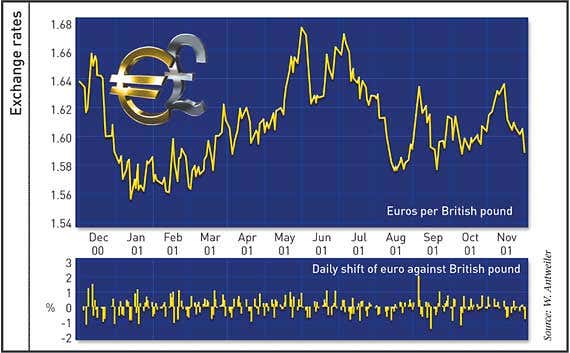
Surprisingly, these revelations are not the work of economists or bankers. They come from a pair of physicists who analysed fluctuations in exchange rates using a technique usually employed to spot patterns in DNA sequences and climate records.
The physicists’ analysis reveals that the exchange rates of sterling and the euro – and before that the Deutschmark and the French franc – have been locked together for years. This follows an announcement by the Organization for Economic Cooperation and Development (OECD) last week that the British economy is already performing as if it were close to the heart of the euro zone, and removes a key economic argument for Britain staying out of the single currency.
Advertisement
Next month euro coins and notes will start circulating in the 12 countries that adopted the euro in 1999 and 2000. Britain has kept its own currency, and if it decides to join will have to satisfy the entry criteria set out in the 1992 Maastricht treaty. These include specified levels for borrowing, debt-to-income ratios and inflation. The only criterion the British economy was thought not to have met yet is establishing a stable exchange rate against the euro. But it now appears that it has already done so.
“False euro”
Marcel Ausloos of the University of Liège, Belgium, and Kristinka Ivanova of Pennsylvania State University have found that the fluctuations in sterling’s exchange rate mimic fluctuations in the euro–and before that fluctuations in Europe’s strongest national currencies.
This can only have happened if Britain is so strongly tied to the European economy that currency traders are already treating the currencies as indistinguishable. “Our study shows the GBP is already part of the EUR,” the researchers say in a report to be presented this week at a London conference on the application of physics in financial analysis.
Ausloos and Ivanova obtained their data from a set of nearly 2000 European currency exchange rates that appeared on the international markets between 1 January 1993 and 30 June 2000. They then created a “false euro”, composed of a weighted sum of the exchange rates of 11 European currencies before the euro was created in 1999. Economists routinely create a false euro. It was also used to set individual currencies’ final values against the euro when they joined.
Peter Richmond of Trinity College, Dublin, who also borrows techniques from physics to understand economics, says Ausloos and Ivanova’s work stands up to scrutiny. He believes their findings show the emergence of the euro as a major trading currency.
For more on this story see New Scientist magazine, 8 December.


