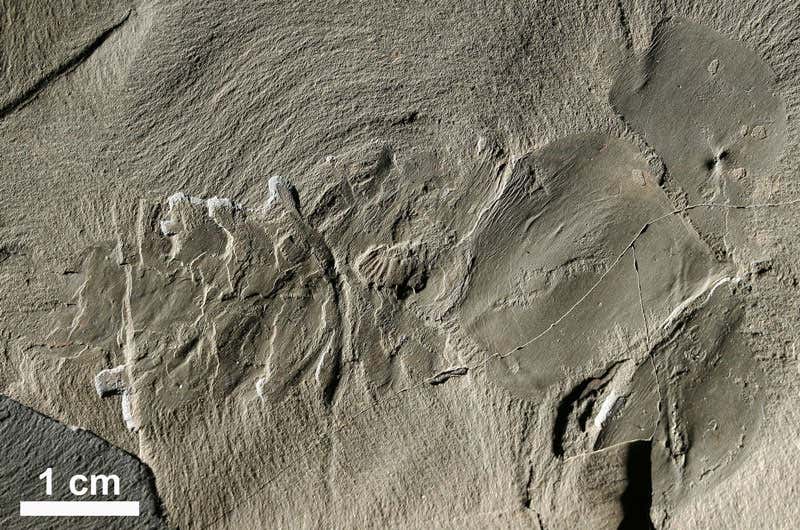
An artist’s reconstruction of Hurdia based on numerous fossils. The large head carapace helped researchers distinguish it from a related Cambrian super-predator, Anomalocaris (Image: Science/AAAS) This Hurdia fossil was uncovered by Charles Walcott and now is part of the collection at the Smithsonian National Museum of Natural History in Washington, DC. The initial description of the specimen left out its carapace, leading to its misidentification. It is one of the only Hurdia fossils, however, to have retained its eyes (Image: Science/AAAS) This dorsal view of a Hurdia fossil unearthed more recently helped researchers unite the various bits and pieces of the marine predator (Image: Science/AAAS) Another recently discovered Hurdia fossil shows the invertebrate in profile. Its body was probably covered in gills, providing large amounts of oxygen to the free-swimming animal (Image: Science/AAAS)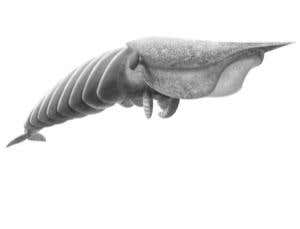


For an animal nicknamed the “T. rex of the Cambrian” – the apex predator of its food chain – the ancient arthropod Hurdia victoria has had a tough time getting properly recognised.
The species was initially described as a crustacean by American palaeontologist Charles Walcott in 1912. But its bizarre appearance and the discovery of numerous partial fossils led to it being misclassified variously as a species of jellyfish, sea cucumber and its close relative Anomalocaris.
Now a new analysis of numerous Hurdia fossils – including the animal’s whale-like carapace – suggests that all these specimens belong to a single species.
Advertisement
“The animal is very strange looking,” says Allison Daley, a palaeontologist at Uppsala University in Sweden, who led the new classification.
She says the early arthropod may have grown to be half a metre long and sat near the top of its marine food chain, some 500 million years ago.
Hurdia is among the most abundant predators in a western Canadian rock formation called the Burgess shale. Study co-author Jean-Bernard Caron, an invertebrate palaeontologist at the Royal Ontario Museum in Toronto, says that Hurdia probably skulked around the bottom of the ocean in large numbers.
Journal reference: Science (DOI: 10.1126/science.1169514)