A great white shark, Carcharodon carcharias, feeds on a whale carcass at Seal Island, False Bay, South Africa (Image: Chris And Monique Fallows / Apex Images Cc / OSF / Photolibrary)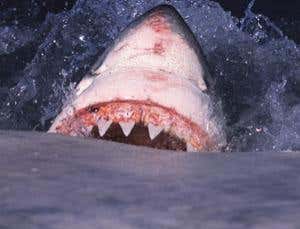
Palaeontologists have discovered a fossilised great white shark tooth lodged in a four-million-year-old whale mandible bone – a first.
A team led by Dana Ehret, of the Florida Museum of Natural History in Gainesville, unearthed the unique specimen in southern Peru’s Pisco Formation, which during the Pliocene, the period around 2 to 5 million years ago, was an ocean.
But did the shark kill the whale, or merely scavenge its corpse? Find out in our gallery
Advertisement
Journal reference: PALAIOS, DOI: 10.2110/palo.2008.p08-077r