Holiday special
Christmas observations of a peculiar “twisting” star have provided a crucial insight into why the Sun’s 11-year sunspot cycle is so unpredictable, according to European astronomers working at the Anglo-Australian Telescope in New South Wales.
The star, AB Doradus, is best viewed over the festive period and for the last 10 years Andrew Collier Cameron, from St Andrews University, and his collaborators have spent the holidays watching its starspots.
A computer reconstruction shows the surface of AB Doradus mottled with giant starspots (Image: Cameron, Jardine, Wood, University of St Andrews)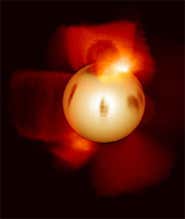
Like sunspots, starspots are created when magnetic fields break through a star’s surface. But in the case of AB Doradus, 1000 times more of its surface is covered by spots than on our own Sun. This is because AB Doradus is young and whizzes round about every 12 hours, creating a strong magnetic field.
Advertisement
Stars are made of gas, meaning different latitudes of a star rotate at slightly different velocities. Analysis of Doppler shift effects in the spectrum from AB Doradus shows that the starspots appear in three main bands, each moving at different speeds.
With 10 years of data, Cameron thought he could pin down the velocity difference between the bands. But he was in for a surprise, because each year’s records did not tally with the next. “I came to the conclusion that the differential rotation was changing from one year to the next,” he says. In other words, the star was ‘twisting’ back and forth.
Feedback loop
This is the first direct evidence for something that has long been suspected – that the magnetic field affects the gas flow inside the star, which generates the field in the first place, creating a feedback loop.
On AB Doradus, the feedback is so strong that it actually arrests the star’s rotational rate until the magnetic field no longer drags on the star. The effect is non-linear and could explain some of the unpredictability of stars’ behaviour.
For an older and slower star, such as the Sun, which rotates about once a month, the effects are subtler. For example, in 2001, the Sun stubbornly refused to end one cycle and begin a new one.
Cameron believes magnetic feedback, albeit on a smaller scale, disrupts the regular cycling of the system. “It introduces that little element of chaos into everything,” he says.
Hoping for more insights, Cameron and his team will be observing again this festive season. “We’re on the telescope from 21 December through 2 January, so we wipe out both Christmas and Hogmanay this year,” he says bravely.