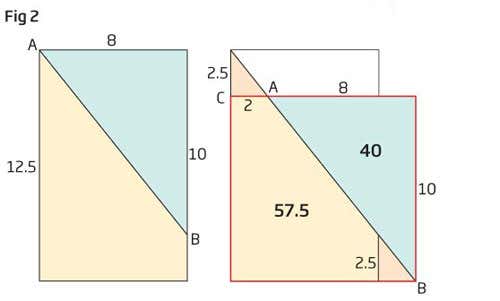
Figure 1 Figure 2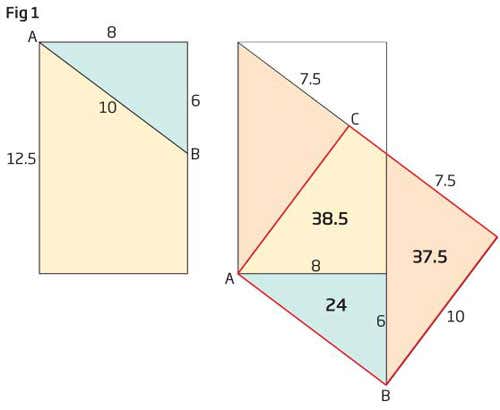
Answer: The area can be either 38.5 or 57.5 square centimetres
Please note we ran this correction in New Scientist:
Advertisement
There were two valid solutions to Enigma 1546 (4 July, p 24): 38.5 and 57.5 square centimetres. A second £15 prize has been awarded to R. F. Tindell of Great Shelford, Cambridgeshire, UK.
The first winner was Narayan Ramanathan of Ahmadi, Kuwait. There were 111 entries.
Worked answer
Once Penny realised that the first cut had to produce a triangle, she also realised that that cut would have produced a 10-centimetre edge as one side of the square (see figure 1).
But she had to be told that there were two ways of doing this (see figure 2).
Penny’s second cut was AC.
Penny found that inserting the dimensions was no problem, nor was calculating the areas.
The area of the largest piece can be either 38.5 or 57.5 square centimetres.