Figure 1, figure 2, figure 3 and figure 4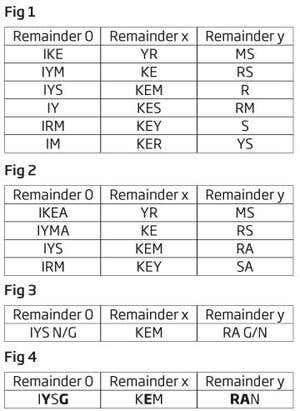
Answer: (a) I (b) 4
The winner is Jeremy Clark of Aston Upthorpe, Oxfordshire, UK. There were 149 entries.
Advertisement
Worked answer
A number is divisible by 3 if and only if the sum of its digits is divisible by 3. Write XYZ ≡ PQ to mean X+Y+Z and P+Q differ by a multiple of 3.
Since IMAGINE ≡ 0 and ENIGMA ≡ 0 it follows that I ≡ 0. So the six numbers being divisible by 3 reduces to the requirements:
- MAY ≡ 0
- I ≡ 0
- MAKNG ≡ 0
- EASY ≡ 0
- ENGMA ≡ 0
- EASER ≡ 0
MAY/EASY have AY in common, EASY/EASER have EAS in common, and MAKNG/ENGMA only differ in the K/E. Hence the conditions reduce to
- MAY ≡ 0
- I ≡ 0
- K ≡ E
- M ≡ ES
- ENGMA ≡ 0
- Y ≡ ER
But then MAER ≡ MAY ≡ 0 and so (comparing with ENGMA) our conditions become
- MAY ≡ 0
- I ≡ 0
- K ≡ E
- M ≡ ES
- NG ≡ R
- Y ≡ ER
We need four letters divisible by 3, three giving the same non-zero remainder (x say) when divided by 3, and the other three giving remainder y (where x and y are 1 and 2 in some order). We tabulate the possibilities using just the four boldface rules above (see Fig 1).
We now use MAY ≡ 0 to place the A where possible (see Fig 2).
We then use NG ≡ R to see where the placing of N/G works (see Fig 3).
Now since the six numbers were odd, {Y, E, G, A, R} = {1, 3, 5, 7, 9}. So at least two remainder-y digits are odd: they must be 1 and 7. So we get the following, with odd digits in boldface (see Fig 4).
It follows that Y/G = 3/9, I/S = 0/6 (but I ≡ 0 since it starts a word), E = 5, K/M = 2/8, N = 4, R/A = 1/7.
Hence certainly I = 6, S = 0, E = 5 and N = 4.