Figure 1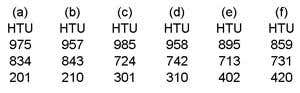
Answer: The three numbers are 325, 784 and 901
The winner is Jeremy Gray from Epsom, Auckland, New Zealand. There were 210 entries.
Worked answer
The sum of the 9 digits used must be between 36 (if 9 is not used) and 45 (if 0 is not used).
Advertisement
So the sum of the digits used in each column must be:
- Hundreds: 20 (less carry from tens)
- Tens: 11 (less carry from units)
- Units: 10
This means that the sums must be: H 19, T 10, U 10; and the unused digit is 6.
19 can be achieved in 3 ways: 9+8+2, 9+7+3, 8+7+4.
10 can be achieved in 6 ways: 9+1+0, 8+2+0, 7+3+0, 7+2+1, 5+4+1, 5+3+2.
Since the tens and units are interchangeable there are 6 possible combinations: see figure 1, right.
Since squares do not end in 2, 3, 7 or 8 and those that end in 0 or 5 always end in 00 or 25, (b), (d) and (e) cannot furnish a perfect square.
We can omit squares that start with 1 or 5 or contain a 6 or a repeated digit, leaving 289 (impossible), 324 (c), 729 (f), 784 (c) and 841 (impossible).
If 324 (c), the other numbers are: 985 and 701, or 905 and 781, or 981 and 705, or 901 and 785.
If 729 (f), the other numbers are: 851 and 430, or 831 and 450, or 850 and 431, or 830 and 451.
If 784 (c), the other numbers are: 925 and 301, or 905 and 321, or 921 and 305, or 901 and 325.
Triangular numbers that start with 3, 4, 7, 8 or 9 and contain neither a 6 nor a repeated digit are 325, 351, 378, 435, 703, 741, 780, 820 and 903.
So 325 is the only triangular number that can be used, along with 784 and 901.


