Figure 1 Figure 2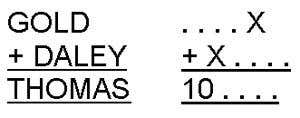

Answer: 103,274
The winner is Simon Scarle of Nuneaton, Warwickshire, UK. There were 89 entries.
Worked answer
It is easier to treat this as an addition problem: 1 2 3 4 5 6
Advertisement
From col 1, T=1; from col 2, H = 0, D = X (the extra digit), and there is a carry from col 3; so A and G are greater than O, and if there is no carry from col 4 (A – O) cannot be 1 because G cannot be greater than 9 (see Figure 1, right).
If there is no carry from col 5 to col 4 or from col 4 to col 3, then A > L, A > E, M > O, M > L:
if A = 6, L and E are 2 and 3 (col 5); with O = 4, G = 9 (col 3), M = 7 (with L = 3), but S and Y cannot be 5 and 8;
if A = 7. L and E are 2 and 4 (col 5); with O = 5, G = 9, M = 7/9 – but A = 7, G = 9; with O = 3, G = 7 – but A = 7;
if A = 8, either L and E are 2 and 5: with O = 6, G = 9, M = 8 (with L = 2) – but A = 8. with O = 4, G = 7, M = 6/9, but S and Y cannot be 3 and 6/9; with O = 3, G = 6, M = 5/8 – but A = 8, L/E = 5;
or L and E are 3 and 4: with O = 6, G = 9, M = 9 (with L = 3) – but G = 9; with O = 5, G = 8 – but A = 8; with O = 2, G = 5, M = 6 (with L = 4), but S and Y cannot be 7 and 9;
if A = 9, either L and E are 2 and 6: with O = 7, G = 9 – but A = 9; with O = 5, G = 7, M = 7 (with L = 2) – but G = 7; with O = 4, G = 6 – but L/E = 6; with O = 3, G = 5, M = 5/9 – but G = 5, A = 9;
or L and E are 3 and 5: with O = 7, G = 9 – but A = 9; with O = 6, G = 8, M = 9 (with L = 3) – but A = 9; with O = 4, G = 6, M = 7 (with L = 3), but S and Y cannot be 2 and 8; with O = 2, G = 4, M = 7 (with L = 5), but S and Y cannot be 6 and 8.
If there is no carry from col 5 to col 4, but there is a carry from col 4 to col 3, then A > L, A > E, O > M, L > M:
from col 5, since A is not greater than 9 and E is not less than 2, L is not greater than 6; if L = 6, then A = 9 and E = 2. Since A is greater than O, O is not greater than 8. But if A = 9 and O = 8, then from col 3 G = 9. But if O = 7 and L = 6, then from col 4 M = 2 – impossible because if L = 6, then E = 2. With any lower value of O or L then M is less than 2, which is impossible.
If there is a carry from col 5 to col 4, but no carry from col 4 to col 3, then L > A, E > A, M > O, M > L; with G > O and A > O (col 3) this means that A, E, G, L and M are all greater than O, and O can only be 2 or (if S = 2, Y = 3) 4. But if S = 2, Y = 3, O = 4, then there must be a carry from col 4 to col 3.
With O = 2, if A = 4, then G = 9 (col 3); if L = 5, then E = 9 (col 5) – but G = 9; if L = 6, then M = 9 (col 4) – but G = 9;
if A = 5, then G = 8 (col 3); if L = 6, then E = M = 9 (cols 4 and 5); and if L is greater than 6 there must be a carry from col 4.
If there are carries from col 5 to col 4 and from col 4 to col 3, then L > A, E > A, O > M, L > M; with G > O and A > O (col 3) this means that A, E, G and L are all greater than O and O is greater than M; M can only be 2 or (if S = 2, Y = 3) 4. A cannot be greater than 7.
If M = 4, then O = 5, L = 9 (col 4), A = 7, G = 8 (col 3), but then E = 8 (col 5);
if M = 2, then O = 5 (if S = 3, Y = 4) or 3:
with O = 5, L = 7 (col 4), G = 9, A = 6 (col 3), E = 9 (col 5) – but G = 9;
with O = 3, L = 9 (col 4), G and A are 5 and 8 or 6 and 7:
if A = 5, G = 8, then E = 6 (col 5) – but S and Y cannot be 4 and 7.
A = 6, G = 7, then E = 7 (col 5) – but G = 7;
A = 7, G = 6, then E = 8 (col 5), leaving Y = 5, S = 4.
So the only solution is the one shown in Figure 2.