Look. No hands. (Image: Mike Jorgenson/Essner/Naturwissenschaften)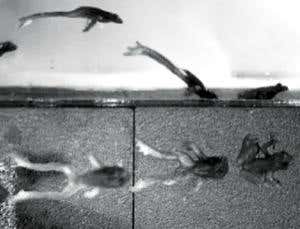
Playing leapfrog would be tricky for the most primitive living frogs: those from the Leiopelmatidae family crash-land rather than touch down gracefully after leaping. The finding may reveal how frog jumping evolved.
Richard Essner of Southern Illinois University in Edwardsville suspected unusual jumping behaviours in leiopelmatids because they are known to swim differently from other frogs, using a “trotting” movement rather than a synchronous double kick.
Essner’s team used high-speed video to compare jumping in three leiopelmatid species with two more-evolved species. Whereas the more advanced species begin to fold up their hind-limbs in mid-air to prepare for landing and their next leap, “Leiopelmatid frogs don’t fold up their legs until after they’ve hit the ground,” he says.
Advertisement
Ascaphus montanus, the most primitive species, kept its legs splayed as it landed in a belly flop or nosedive, then skidded to a halt on its belly (Naturwissenschaften, DOI: 10.1007/s00114-010-0697-4). Perhaps it’s no surprise that frogs evolved to jump before they could master landing.
Topics: