What the Victorians were missing (Image: Andrew Carol)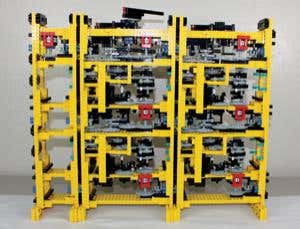
Make your own ancient Lego tech: “No magnet required: How to build a compass out of Lego”
History’s greatest fantastical contraptions – the Difference Engine and the Antikythera mechanism – are back, with a playful twist
ANDREW CAROL’S computers can calculate the solutions to mathematical equations and tell you the exact time and date of a lunar eclipse several hundred years into the future.
Yet these machines compute without a hint of silicon. They crunch numbers without hard drives, wires or batteries. All Carol needs to build his computers are plastic blocks, gears and a hand-operated crank, because his machines are made entirely out of Lego.
Carol’s creations are Toys-R-Us meets steampunk, the science-fiction genre in which modern technology is anachronistically re-imagined in pre-20th century materials like brass, wood and leather. One of his machines is a 1000-piece Lego reconstruction of the Difference Engine, a Victorian mechanical calculator designed to crunch the answers to mathematical formulae automatically. His latest creation is a Lego-based Antikythera mechanism, an ancient Greek machine considered by some historians to be the world’s first computer. With about 2000 parts and 100 gears, it can calculate the position of the sun and moon in the sky centuries ahead of time, something you might expect from a smartphone app but not from a bunch of plastic bricks.
To be sure, he operates outside the traditional Legoverse: you won’t find many standard Lego bricks in Carol’s home in California, and you certainly won’t see any of the iconic, tiny yellow men known to fans as “minifigs”. Instead, stacks…