Striking shape (Image: George Grall/Getty)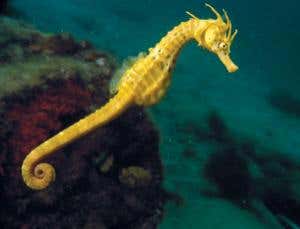
It is easy to forget that the seahorse is a fish. With its equine head, potbelly and prehensile tail, it rivals the platypus in its peculiarity. But the seahorse’s form is not just for show: its arched neck acts like a spring that stores energy, ensuring it is ready to strike when it spots a meal.
Biologist Sam Van Wassenbergh at the University of Antwerp, Belgium, and colleagues created mathematical models based on the body shape of seahorses and their straight-bodied cousins, pipefish.
The models revealed that seahorses’ necks have the elasticity and stability needed to let them lunge forward and grab a passing shrimp, even if it is some distance away. Pipefish, in contrast, cannot strike out so far and must settle for closer prey.
Advertisement
This bend and snap technique is a vital hunting method for most seahorse species, as they are weak swimmers. “Every extra millimetre you can reach becomes important because it means more food,” says Van Wassenbergh. Seahorses enjoy a 20 per cent increase in their strike zone thanks to the shape of their head and neck, he says.
“Like everyone, I have always wondered why seahorses look so bizarre,” says Adam Jones at Texas A&M University in College Station. “This is the first step in establishing it’s an adaptation.”
Journal reference: Nature Communications, DOI: 10.1038/ncomms1168
Topics: