Forget the gas-guzzling SUV – researchers have taken a tiny car made of a single molecule out for a drive.
To build the micromachine, a team from the University of Groningen in the Netherlands created a molecule with a long central body and four paddles that work like wheels.
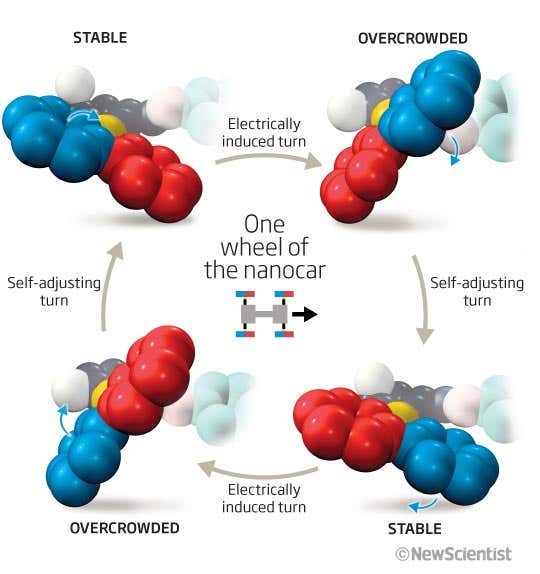
Ordinarily, the paddles would arrange themselves in their lowest-energy state, which minimises crowding with the central body (see image). But when the team applied a pulse of electrons, some gained energy and turned.
To keep the nanocar from rolling backwards, temperatures of 7 kelvin (-266 °C) froze its paddle “wheels” in place except when excited by the electron pulse.
Advertisement
Next, the team hopes to attach a tiny trailer to the back of the molecule to make a nano train set and use it to transport miniature cargoes within microscopic systems. “We have a locomotive,” says nanocar team member Karl-Heinz Ernst, “but it’s time to put some cars at the back and pull them along.”
Travelling in a nanocar means a slow road trip: it takes 10 pulses of electric fuel to move the vehicle 6 nanometres, whereas the head of a pin is about 1 million nanometres wide.
Story 2 of 6
Next: “Electrons line up for magnetic memory“
Previous: “Record-breaking motor is tiniest ever“
See all Molecule magic articles


