(Image: CDC/Phanie/Rex Features)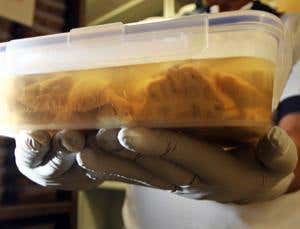
A freezer failure at the world’s largest repository of human brains has led to the loss of 147 of them, including a rare collection of 53 brains from donors with autism.
Researchers at the Harvard Brain Tissue Resource Center at McLean Hospital in Belmont, Massachusetts, only noticed the thaw – on 31 May – when they opened the freezer door; the temperature display still read -79 °C. The rising temperature had also failed to trigger two alarm systems on separate circuits.
Camera footage suggests that the perfect storm of technical failures was not due to foul play, but McLean spokeswoman Laura Neves says nothing has been ruled out at this stage. Two internal investigations into the failure are under way.
Advertisement
The good news is that some information may be salvageable. All 53 autistic brains and 12 others had been cut in half, with one half frozen and one half preserved in formaldehyde. The preserved tissue remains available for study.
Topics: