The Tadpole spiral galaxy was distorted after collision with a compact, blue galaxy (upper left corner) (Image: NASA/ACS Science team)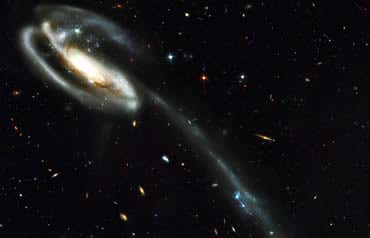
Spectacular shots of galactic collisions and newborn galaxies from the Hubble Space Telescope’s new camera have delighted astronomers. The Advanced Camera for Surveys (ACS) was installed two months ago, with the first images released on Tuesday.
“My colleagues and I were stunned” by the details shown in a picture of two galaxies colliding 420 million light years away, said principal investigator Holland Ford of Johns Hopkins University at a NASA press conference. But they were most awed by a multitude of faint galaxies they saw in the background, some apparently dating back to just a billion years after the Big Bang.
The new camera increases Hubble’s sensitivity ten-fold. One image shows a previously unseen tail of gas and young stars stretching 280,000 light years from the colliding galaxies dubbed “the Tadpole”.
Advertisement
The Tadpole background shows twice as many galaxies as the “Hubble Deep Field” image taken in 1995, yet the ACS required only one-twelfth of the time to record its image.
The Cone Nebula is a giant pillar of gas and dust residing in a turbulent star-forming region (Image: NASA/ACS Science team)
The youngest objects in the new picture are seen only about a billion years after the Big Bang, but astronomers hope to go further back, to the “twilight zone” when galaxies began to form.
Ford said one possible way to reveal more distant, even younger galaxies is to look at dense clusters of galaxies, which can gravitationally focus light. Garth Illingworth of the Lick Observatory says to see further back “we may need the Next Generation Space Telescope,” which will observe in the infrared.
Power boost
Shuttle astronauts replaced the last of the original Hubble instruments, the Faint Object Camera, with the new camera in March. They also replaced Hubble’s power distribution system and solar panels.
The upgraded electrical system and solar cells deliver 27 per cent more power than the old one, doubling the power available for instruments, said Preston Burch, Hubble Project Manager at NASA Goddard Space Flight Center.
However, troubles have surfaced with a gyroscope that had been drawing excess power before the repair mission. It had worked normally after power was restored, but is again drawing more power.
“It may last several months,” or could go any time, said Burch. Hubble has suffered gyro failures in the past, but has spares on board.


