“The Mice” as captured by Hubble’s Advanced Camera for Surveys (Photo: NASA/ACS Science team)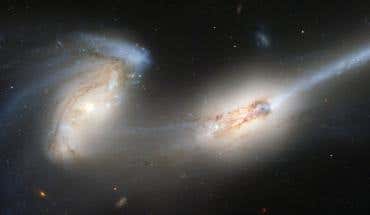
A spectacular inter-galactic collision, imaged by the Hubble space telescope’s new camera, has been recreated in a new computer model that allows astronomers to estimate the date when the galaxies’ first met. The model also suggests when the pair will fully merge, and tests existing theories of galactic mergers.
The two galaxies are 300 million light years from Earth and together they are known as NGC 4676. But they have also been dubbed “The Mice”, thanks to their long tails.
Hubble’s new Advanced Camera for Surveys revealed new detail of the Mice and Joshua Barnes of the University of Hawaii and John Hibbard at the US National Radio Astronomy Observatory used the images to select with the most accurate computer model.
Advertisement
“It looks as if The Mice were a bit late getting together,” said Barnes. “But eventually they’ll make up one more elliptical galaxy in the Coma Cluster.”
The model indicates that the galaxies first swung past each other 150 million years ago and indicates that they will come together to finally form a single elliptical galaxy some 400 million years from now.
This frame of the computer simulation shows the galaxies as they appear now (Photo: University of Hawaii)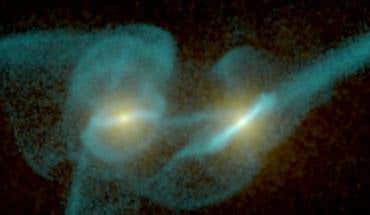
MPEG videos showing the simulated collision can be viewed here (3.4MB) and here (2.4MB) (hosted by the University of Hawaii).
The researchers began with a number of possible scenarios for the collision and then selected the one that best fitted the new Hubble observations. The two galaxies can currently be seen in what astronomers suspect to be the early stages of huge impact. Previous computer models and observations have provided some insight into their clash, but the new model provides much more detail.
David Clements, at Imperial College London, says that computer models can provide astronomers with insight into the history of the Universe. He told New Scientist: “By studying objects like The Mice, we’re not only probing the physics of what’s happening to galaxies now, we’re also looking at local analogues as a key to understanding the early stages of galaxy formation.”
He says computer models, such as the one created by Barnes and Hibbard, are now much more realistic: “Previously astronomers have been looking at how particles operated just under gravity, without any hydrodynamics. But gas reacts like a fluid so you get pressure and mixing.”
However, Clement also notes that computer models can lack the resolution needed to model galactic phenomenon with complete accuracy. This is highlighted by some minor anomalies between the computer simulations and the Hubble images of The Mice.
Barnes says: “We can probably improve our calculations, but we’re definitely on the right track.”