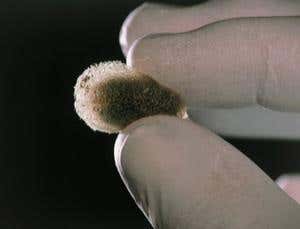
Encased Vorticella-like fossil (Image: Benjamin Bomfleura, Hans Kerp, Thomas N. Taylor, Øjvind Moestrup, and Edith L. Taylor/PNAS) Worth a closer look (Image: Geoff Tompkinson/SPL)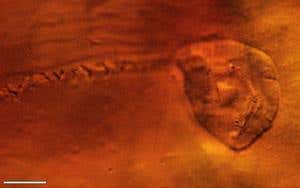
Move over amber. When it comes to preserving soft-bodied animals through the ages, there’s a newcomer in town: fossilised leech “cocoons”.
The cocoons are secreted by many leech and worm species as mucous egg cases that harden and often fossilise. Almost two decades ago, Norwegian scientists found a perfectly preserved nematode worm embedded in the wall of a fossilised cocoon, but no one had investigated further.
So when Benjamin Bomfleur, a palaeobiologist at the University of Kansas, and his colleagues found fossil cocoons in 200-million-year-old rocks from the mountains of Antarctica, they took a closer look. They dissolved the rock with acid, leaving only the organic material – mostly leaf litter, but also 20 leech cocoons squashed flat by the pressure of aeons. One contained a perfectly preserved ciliated protozoan that appeared identical to modern single-celled “bell animals” (Vorticella) that live in ponds and streams.
Advertisement
The find is one of only a handful of fossilised ciliated protozoans. It suggests leech cocoons could be conservation traps in which, like amber, rarely fossilised creatures might be found.
Journal reference: PNAS, DOI: 10.1073/pnas.1218879109
Topics: