Geomagnetic storms and erosion of the atmosphere are the price the Earth pays for protection from bursts of solar particles.
Two years of observations by NASA’s IMAGE spacecraft, released on Thursday, show that each solar outburst blows about 100 tons of oxygen out of the outer ionosphere. Most of this is lost in space, but a small fraction is trapped by the Earth’s magnetic field.
These particles carry extremely high energy and it is they, rather than solar particles, that trigger geomagnetic storms, said NASA’s Richard Fisher, division director of the Sun-Earth Connection.
Solar outbursts cause an increase in the intensity of the solar wind (Photo: NASA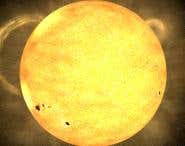
Advertisement
Geophysicists have long known that solar outbursts trigger geomagnetic storms, but they had not recognized the contribution of ions from the Earth’s atmosphere.
So-called “space weather” can disrupt long-distance radio transmission, disable satellites and, in extreme cases, knock out electric power grids. Scientists have become increasingly interested in the phenomena with the growing use of satellites for communications and global positioning.
Hot ions
However the physics involved have been poorly understood, making it hard to predict space weather. The IMAGE observations reveal new interactions between the upper atmosphere and solar particles, showing “the Earth is an active participant in space weather,” Fisher said.
Normally the magnetosphere diverts most of particles in the solar wind around the ionosphere, forming a ring of current above the ionosphere. Solar outbursts multiply the strength of the solar wind, generating extremely high currents. These heat ions in the upper ionosphere, 1000 kilometres up, to 100,000 times their normal energy.
The IMAGE measurements show “the energy of the solar wind builds up slowly, but is released episodically” as bursts of particles escape from the atmosphere, said Donald Mitchell of the Johns Hopkins Applied Physics Laboratory in Laurel, Maryland.
Most of these hot oxygen ions escape the Earth’s gravity, but some are trapped by its magnetic field, and flow from the daylight side to the night side, where they are captured in a tail behind the planet. It is these high-energy ions from the atmosphere that generate the strong currents and geomagnetic storms.
The refinements in our understanding of the process will rewrite textbooks on space physics and the upper atmosphere, Fisher predicted.


