Astronomers have seen the seeds of the first galaxies in the cosmic microwave background (CMB), also known as the echo of the Big Bang. The observations could answer the question of how galaxies form in the first place.
The CMB dates to the moment 300,000 years after the Big Bang when the opaque plasma of protons and electrons combined to form atoms that light could pass between, making the Universe transparent.
The CBI image maps fluctuations equivalent to just 1/10,000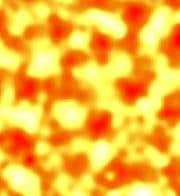
Since 1992 astronomers have known the microwave background is not uniform across the sky but is broken up into brighter and darker blobs, corresponding to regions of higher and lower density in the original plasma.
Advertisement
Now researchers at California Institute of Technology in Pasadena and the Canadian Institute for Theoretical Astrophysics in Toronto have used the Cosmic Background Imager (CBI), a series of radio antennae in the Atacama Desert, Chile, to map out these blobs more precisely than ever before.
The size of the largest blobs confirms previous results that the Universe is mainly repulsive dark energy, which blows the blobs apart, only five per cent normal and dark matter whose gravity holds them together. But the resolution of the CBI is good enough to see an even smaller population of blobs.
“The CBI is seeing the seeds of galaxy clusters” says Anthony Readhead of Caltech. The seeds are a tenth the diameter of the full moon.
Photon deflection
But to the surprise of researchers, the experiment has seen many more tiny blobs than was expected. Most likely, say the researchers, some of the darker blobs are caused by photons of the CMB being deflected by hot gas in galactic clusters between their origin and us.
If this is true, then the pattern of the blobs is telling astronomers about clusters of galaxies too far away to be seen directly. “This is a very promising but tentative detection,” says Tim Pearson, Readhead’s colleague.
But Rafael Rebolo of the Astrophysical Institute of the Canaries in Spain, who with groups at Cambridge and Manchester Universities in the UK announced similar but lower resolution measurements of the CMB on Thursday, says he will be looking carefully at the competing group’s results.
“We are mapping all the radio sources in the sky which could be confused with the microwave background at this resolution,” he says. “They haven’t done this as carefully.”