(Image: Laurence Jackson)
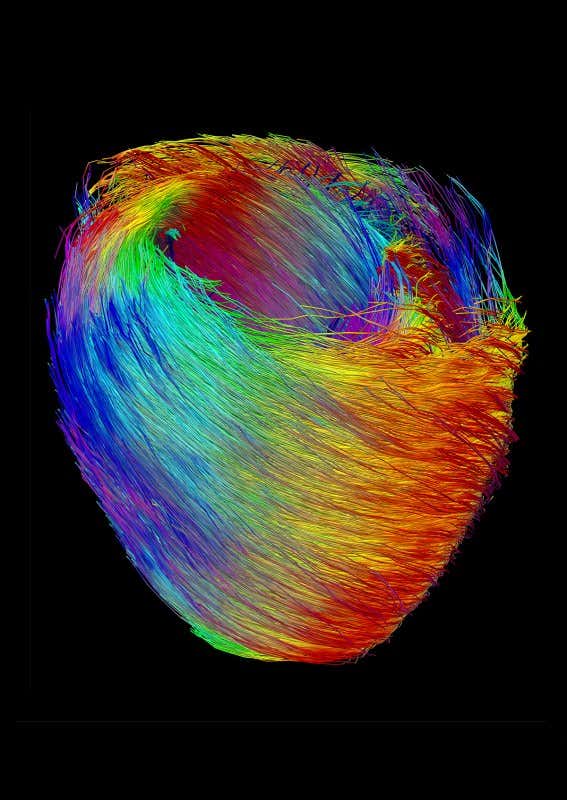
This is not a colourful bird’s nest: it is the collection of muscle fibres that work together to make a mouse heart beat.
Laurence Jackson from University College London captured the vivid MRI picture using diffusion tensor imaging, which tracks the movement of fluid through tissue, using different colours to represent the orientation of the strands.
Advertisement
The fibres, which spiral around the left ventricular cavity, curve in different directions around the inside and outside walls of the chamber. When the fibres pull against one another, the result is an upwards twisting motion that forces blood to be pumped out.
The image, which was the overall winner of the Research Images as Art/Art Images as Research competition last year, is currently on display at the Summer Science Exhibition taking place at the Royal Society in London. It is part of an exhibit run by the Centre for Advanced Biomedical Imaging at University College London that showcases future imaging techniques that will allow us to peer inside the body.
Topics: