Mission now possible: the Europa Clipper probe (Image: JPL/Nasa)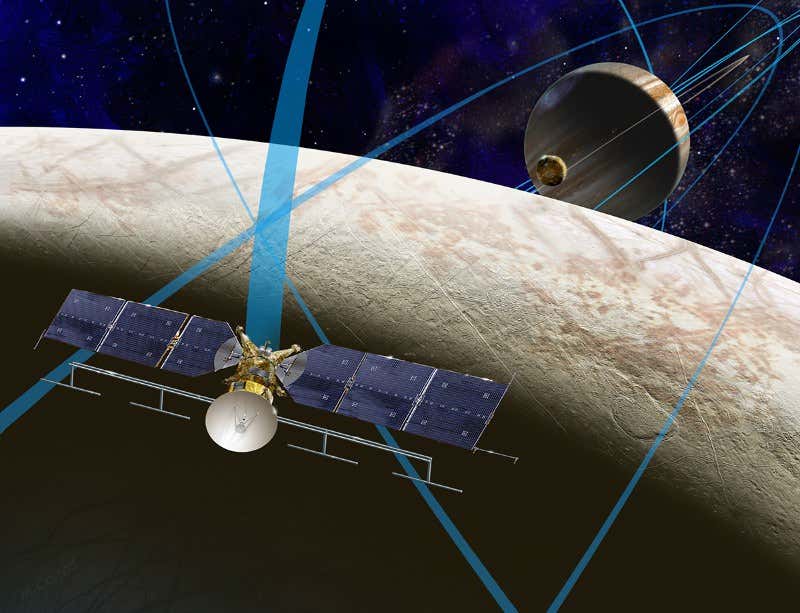
Pack your ice gear – we’re going to Europa. NASA’s budget request for 2016 includes $30 million for a dedicated mission to Jupiter’s icy moon, which is considered one of the best prospects for discovering life in our solar system.
Europa has been a tempting destination for planetary scientists since the mid-1990s, when the Galileo orbiter revealed that it may harbour a deep ocean of briny liquid water beneath a thick icy shell. More recently, reports that plumes of subsurface water could be venting into space sparked calls for a mission to sample that water directly and see if anything lives in it.
Last year, NASA received $100 million from Congress to begin preliminary work on such a mission, but was missing the commitment to further funding for a period long enough to plan a mission.
Advertisement
Now, with another $255 million budgeted over the next 5 years, NASA is giving a clearer green light. “For the first time, the budget supports the formulation and development of a Europa Mission, allowing NASA to begin project formulation,” the budget request reads.
The mission will probably involve a spacecraft orbiting Jupiter and making multiple fly-bys of Europa, rather than landing on or orbiting Europa itself. This will make the mission much cheaper and safer, as Europa sits in a harsh radiation environment that can be dangerous for spacecraft. NASA will choose instruments for the spacecraft in spring this year, and aims for a launch date in the mid-2020s.
“This is a big deal,” says Robert Pappalardo at NASA’s Jet Propulsion Lab in Pasadena, California, the pre-project scientist for the Europa Clipper probe concept. “We’re moving toward the next phase, where you’re a real mission. It’s just thrilling after 15 years of pushing for it. It’s a great day.”
Topics: