Our own Sun may eject a similar nebula in about five billion years (Image: NASA/StSci/AURA)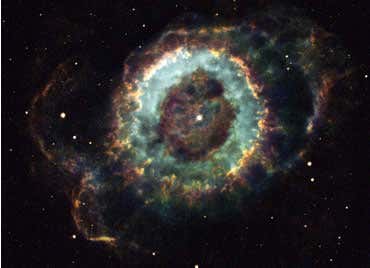
The glowing remains of a dying star have been captured by the Hubble Space Telescope. The new image clearly shows the end-stage red giant star expelling its outer layers into space.
The “Little Ghost nebula”, also known as planetary nebula NGC 6369, is between 2000 and 5000 light years from Earth, in the direction of the constellation Ophiuchus.
When a star with a mass similar to that of our own Sun nears the end of its lifetime, it expands to become a red giant. This stage ends when the star ejects its layers, forming a gaseous, faintly glowing nebula.
Advertisement
Earth’s atmosphere blurs images of the ejection process taken using telescopes on the ground. But Hubble’s Wide Field Planetary Camera 2 clearly shows a blue-green ring of surrounding gas, almost a light-year in diameter. In this region, a flood of UV light produced by the dying star has stripped electrons off atoms in the gas.
In the redder zone further away from the star, the UV light is less intense and this ionisation process is less advanced.
The gas is expanding away from the star at about 24 kilometres per second. When it has gone, a process that will take about 10,000 years, the remains of the star will gradually cool off over billions of years as a tiny white dwarf star.


