The largest sunspot in Active Region 10030 is 10,000 kilometres in diameter (Image: Royal Swedish Academy of Sciences)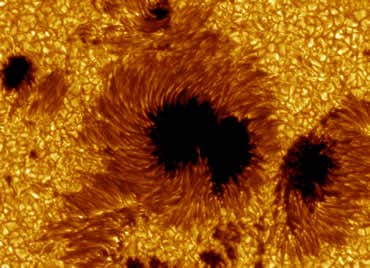
Dramatic new images of sunspots are reminding astronomers what a complicated and chaotic place the Sun really is.
This colour-enhanced image, considered to be one of the most detailed yet taken of the Sun, was taken in July using a one-metre solar telescope on the Canary island of La Palma.
The largest sunspot is roughly 10,000 kilometres wide. But surrounding it are many bright, spidery filaments, 100 kilometres wide, which have unexplained dark cores.
Advertisement
Astronomers are stumped as to how these smaller filaments form, say Dan Kiselman and his team from Stockholm University Centre, Sweden, who obtained the image.
Studying sunspots will help scientists understand the Sun’s magnetic fields, which can disturb telecommunications and satellite operations on Earth.


