The image on the 4000-year-old gourd fragment (left) reveals the fanged teeth and splayed feet of the “staff god” when drawn (right) (Photo: Jonathan Haas, Drawing: Jill Seagard, The Field Museum)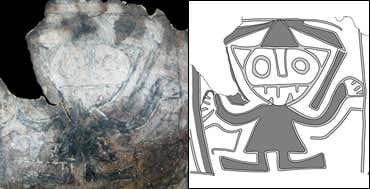
The two key pieces are incised with an image of the fanged “staff god”, a major deity in later Andean cultures. They were discovered at a burial site in the Patavilca River valley and dated using carbon isotopes.
The site is in the Norte Chico region, 200 kilometres north of Lima, which was densely populated from 2600 to 2000 BC. The people left little graphic evidence behind as, while they built large stone monuments and pyramids, they did not sculpt or decorate stone, and lacked pottery.
They did embellish textiles, but only small pieces survive and their dyes have faded away. The cartoon-like image on the gourd is the oldest clear depiction yet found.
Advertisement
Archaeologists call the figure the staff god because he is always depicted holding a staff. He usually has both fanged teeth and clawed feet, and snakes often appear in his headdress or garments. He appears in later Andean cultures until the 16thcentury, when Europeans overthrew the Inca empire.
Complex society
The team of US and Peruvian archaeologists that found the gourd were studying the beginnings of irrigation. Winifred Creamer of Northern Illinois University says implementing such technology requires a highly organised society, and that religious symbols are also important in complex groups.
Simpler cultures usually have kinds of shamanism, she says, which focus on healing rather than the common symbols of gods
The gourd fragments were in a dry, sandy burial site, which had been looted in modern times, leaving them on the surface.
“This is a lucky find,” comments Richard Burger of the Yale Peabody Museum in New Haven. Gourd fragments are common at the site, but very few are decorated. “To find something like this preserved on the surface is being blessed by the gods.”


