This 360-degree image was one of the first received by mission control at NASA’s Jet Propulsion Laboratory (Image: JPL/NASA)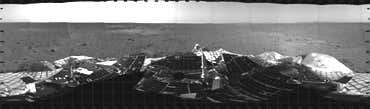
The images of the surface of Mars now flowing in from NASA’s rover Spirit have allowed mission managers to begin planning the robot explorer’s first excursions.
The craft, which landed early on Sunday, has now swung out its high-data-rate antenna into position. This can communicate directly with Earth and is being used to relay back full-color, high-resolution images from Spirit’s panoramic camera. These will then be assembled into a 3-D panorama of the landing site.
The panorama, along with images from a thermal emission spectrometer, will give clues as to the composition of nearby rocks and allow Spirit’s science team to plan the rover’s initial route once it rolls off its landing platform sometime next week.
Advertisement
Another 360-degree panorama looks down on Spirit, with the horizon forming a circle around the lander (Image: JPL/NASA)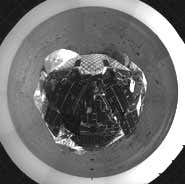
But even with just the low-resolution black and white images seen so far, the team already has some ideas of where they would like to go. One tempting target is a nearby smooth, sandy-looking depression that might be an impact crater. It seems to have an exposed lip that might reveal the layers of rock beneath the surface.
However, lead scientist Steven Squyres of Cornell University is cautious, saying the material in that smooth area might turn out to be loose and fluffy, and thus a potential trap for the rover’s six wheels.
Mistaken identity
Notably absent from the smooth plain surrounding the lander are any large boulders – the dominant feature in the landscapes seen by all three of the previous successful landers on Mars (Viking 1 and 2 in 1976, and Pathfinder in 1997).
Initially, it was thought that a large rock was positioned right at the edge of the Spirit’s exit ramp. But that now appears to be just part of the craft’s own airbags, used to cushion its landing, that failed to retract completely.
The only thing about Spirit’s mission so far that is less than optimal is the condition of the Martian atmosphere itself. Thermal measurements suggest it is slightly dustier than expected.
That may reduce to about 80 per cent the efficiency of the solar panels that power the rover. But Jennifer Trosper, manager of surface operations, says this is well within the design margins and should not substantially affect its capabilities.


