The debate over whether to build the world’s biggest nuclear fusion facility in France or Japan is going critical. The European Union says it could pull out of the international project and build its own, if the project goes to Japan. But the US has firmly backed Japan as its preferred site.
The ITER (International Thermonuclear Experimental Reactor) project aims to lay the groundwork for the eventual use of nuclear fusion as an inexhaustible and environmentally friendly energy source. The French and Japanese sites are the only contenders left from a list that also included sites in Canada and Spain.
“Of course it would be extremely expensive [to go it alone], but the EU could find the money,” EU Research Commission spokesman Fabbio Fabbi told New Scientist.
Meanwhile, the Japanese science and technology minister began a three-day trip to South Korea, Russia, and China and on Wednesday to promote the northern Japanese city of Rokkashomura.
Advertisement
Earthquake risk
An international consortium made up of the EU, Russia, Japan, China, Canada, South Korea and the US failed to agree on a site at a meeting in Washington DC, on 20 December. Three days later, Canada pulled out of the project.
Meetings at the end of January in Japan and Belgium will set out the respective advantages of Rokkashomura and the southern French city of Cadarache. They will consider factors such as earthquake risk and how amenable the local population is to a nuclear installation. But initial hopes of a final decision by mid-February seem increasingly improbable.
US Energy Secretary Spencer Abraham upset France on 9 January by saying the fishing town of Rokkashomura offered a better site because large equipment could be brought in by sea.
Critics allege the US support for Japan is to punish France for its opposition to the war in Iraq, or to enlist Japan’s help in an expensive particle accelerator project called the Linear Collider.
Whatever the motivation, the decision is being based purely on politics, says ITER’s former deputy director Ronald Parker, at the Massachusetts Institute of Technology. “No scientists are being consulted about the advantages or disadvantages of each location,” he told New Scientist.
Carve up
Parker says both sites have been judged technically feasible, but notes that Rokkashomura’s remoteness may make it less attractive for the researchers who will live on site. Cadarache also has “an existing fusion infrastructure”, he says, being the site of previous world records for sustaining nuclear fusion reactions.
One possible solution might be to divide the project up between the countries, with planning and design done at one site and the actual experiment at another. “I think that’s the hope in terms of breaking the stalemate,” says Parker. He adds that researchers in different countries have collaborated effectively since 1986 on planning ITER.
Generating energy economically by fusing atomic nuclei together would revolutionise energy production. But decades of research have failed to achieve this. Parker says ITER is “the only hope in my lifetime” of making significant progress.
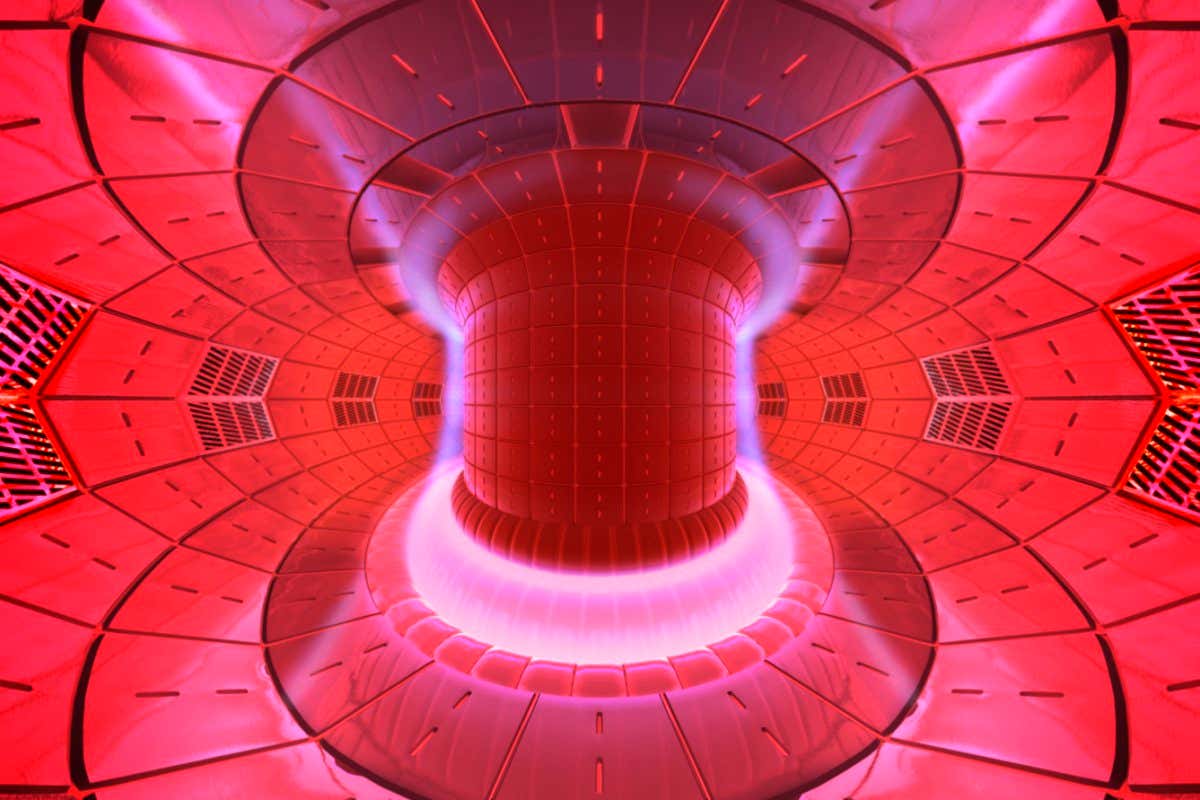
The project would heat atoms derived from seawater to millions of degrees, creating a plasma of charged particles. Magnetic fields would contain the plasma and spur the atomic nuclei to fuse. This would generate heat that, if the project worked, would sustain the reaction for about half an hour and release five times the amount of energy that was initially put in.
Topics: