A close-up image of an undisturbed patch of Martian soil has revealled a large number of hollow spheres or tubes (Image: NASA/JPL/US Geological Survey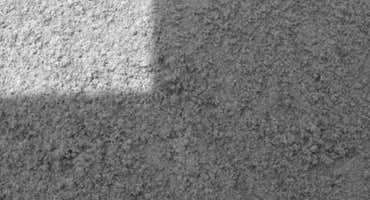
The Mars rover Spirit has completed its first full set of scientific measurements with the instruments on its robotic arm, revealing mysterious hollow grains in the soil.
The one-metre arm used its microscope to take a close-up image of an undisturbed patch of soil next to the NASA rover. It shows mostly sand-sized particles, but with a large number of apparently hollow spheres or tubes. The image resolution is about 30 microns per pixel – about the width of a human hair.
Such grains were completely unexpected. But John Grotzinger, a geologist at the Massachusetts Institute of Technology, says they closely resemble formations he has seen in soils in the southwestern deserts of the US. “There are little tubes that build up by capillary action,” he told New Scientist, as salty water evaporates from the nearly-dry soil.
Advertisement
The Martian grains must also be strong enough to withstand the region’s strong winds and perpetual scouring by dust devils – tornado shaped vortexes that can tower to heights of kilometres.
Triple point
The pressure and temperature conditions at Spirit’s landing site, Gusev crater, are close to the triple point of water, Grotzinger says. This means any water present could change phase between solid, liquid and gas in response to small changes in conditions, and it is an area whose temperatures vary widely during the daily and seasonal cycles.
Pure liquid water cannot be stable at the site under present conditions, says Grotzinger. But a brine might be as the dissolved salts would change the freezing and boiling temperatures.
Other scientists suggested in 2003 that brines in the soil might explain other puzzling Martian features seen in images taken from orbit by Mars Global Surveyor. These are thousands of dark gully-like streaks seen on the walls of some craters and canyons.
But Grotzinger warns that it is far too early to rule out alternative explanations, such as dust that has been clumped together by electrostatic forces. This has previously been suggested to explain some crusty soil seen by the Pathfinder lander in 1997.
But, whatever is causing these unusual features, Grotzinger believes the rover’s multiple spectrographic tools and trench-digging capabilities give it a very good chance of finding out.