Scientists believe the layered rocks are either volcanic ash deposits, or sediments laid down by wind or water (Image: NASA/JPL/Cornell)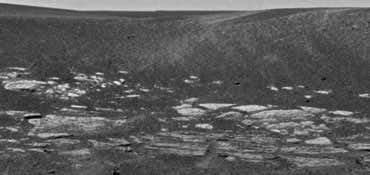
New images transmitted from the Mars rover Opportunity have revealed tantalising signs of sedimentary rocks, the very thing mission geologists are most hoping to find.
A long outcrop of light coloured bedrock has riveted the science team’s attention and now the new 180° segment of high-resolution imagery from the panoramic camera has revealed clear layers, many just a centimetre thick.
The whole outcrop is only a 50 cm thick or less, so the rover will be able to examine it up close without danger of getting stuck. Lava flows are the presumed source of most Martian rock but Steve Squyres, head of the science team, says these can be ruled out because they would form much thicker layers.
Advertisement
However, falling ash from volcanoes can form similar layered deposits, he cautions. Arguing against are hints of a geological feature called crossbedding, caused by ripples or dunes and a clear indication of sedimentary origin.
The quest for proof of sedimentation, which could prove that bodies of liquid water existed for some period of time in the history of Mars, is one of the primary goals of NASA’s twin-rover mission. The two landing sites, halfway around the planet from one another, were specifically chosen to give the best chance of finding clear signs a watery past.
Foaming at the mouth
Such evidence has proved elusive so far at Spirit’s landing site in Gusev crater. But Meridiani Planum, chosen for its unique deposits of hematite that cover an area larger than England, promises to exceed the geologists’ expectations. “The geology group is practically foaming at the mouth” to get close to the layered outcrop, Squyres says.
The hematite will be investigated principally by Opportunity’s infrared spectrograph, called the mini-TES. But preliminary analysis suggests the iron oxide, which usually forms in water, is a major component of the fine grained soil.
But it is the finely layered lighter rock that has been the surprising bonus, as such detail was invisible from orbit. Andrew Knoll, a geologist from Harvard University and science team member, said this mission provides an opportunity on Mars to study these formations at scales from tens of microns up to tens of kilometers – “a uniquely exciting set of linked observations”.
The answer to whether the formation is a volcanic ash-fall or water-laid sediments could be obtained in days, or a few weeks at most. Finding that answer, Squyres said, will make this “the coolest geological field trip in human history”.