Hundreds of thousands of strokes could be prevented each year by a simple mesh cylinder that diverts blood clots away from the brain, claims the company that developed the device.
It was implanted in a patient for the first time late in 2003. Strokes are the second most common cause of death in the western world, and those who survive are often left disabled.
The most common cause is a blood clot elsewhere in the body breaking off and travelling to the brain, where it blocks one of the small blood vessels. This deprives cells of oxygen, killing off part of the brain.
The diverter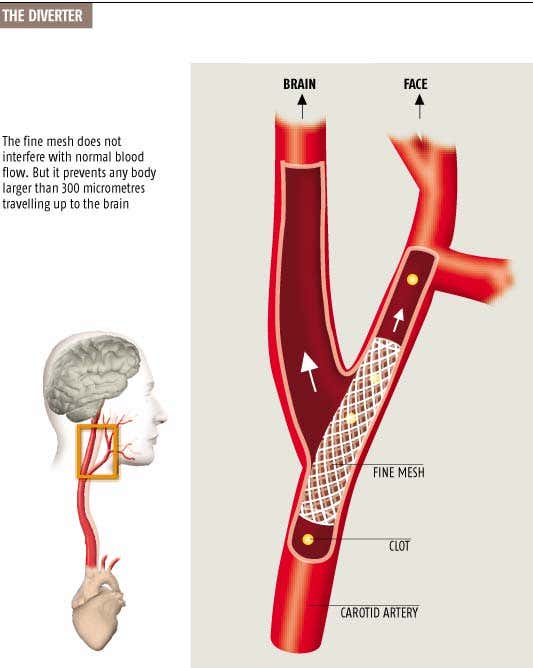
Advertisement
The “Diverter”, developed by Ofer Yodfat’s team at the company MindGuard of Haifa, Israel, is simply a fine-mesh tube. It is placed in each of the two carotid arteries in the neck at the point where they fork. One branch carries blood to the brain and the other to the face (see graphic). The device is placed so it leads into the branch leading to the face.
Blood can still flow through the mesh into the branch feeding the brain, but clots or any kind of debris more than 300 micrometres in diameter cannot pass through and are swept towards the face.
While a damaged face would be far less serious than a damaged brain, Yodfat says patients do not even need to worry about their visage, as the face is so well supplied with blood that any blockages would be harmless.
Clog up
“The device makes sense because about 40 per cent of strokes are caused by blood clots from the heart or arch of the aorta,” says Peter Rothwell, director of the Oxford Stroke Prevention Research Unit at the University of Oxford. He says the Diverter could provide an alternative to giving high-risk patients anti-clotting drugs, which can sometimes cause life-threatening bleeding.
MindGuard envisages the device being implanted in people with a history of heart disease, valve disease or some other potential cause of clots. It would, however, not prevent strokes caused by clots that form after the fork in the carotid artery.
And only a large trial could rule out the possibility that the Diverter itself might cause clots to form, Rothwell warns. Another big worry is that the mesh might clog up, restricting the flow of blood to the brain. The company says it has carried out extensive tests in pigs which show that this is not a problem.
“It is not inevitable that the device would clog up and become non-functional,” says David Williams of the University of Liverpool, UK, an expert on implants. But to satisfy doctors the company will have to publish details of its studies proving this, he says.
The first Diverter was recently implanted in an 80-year-old woman considered to be at high risk of a stroke, Yodfat told New Scientist. The device is inserted through the groin, using a standard procedure. Three months on, he says, she is healthy and stroke-free.


