Smart cellphone antennas that reduce the number of masts needed to get the new 3G broadband mobile networks up and running – and minimise “dead” spots in phone coverage to boot – will be tested on a novel network during the Olympic Games in Athens this summer.
Because 3G networks use different frequencies from those used in today’s GSM system, they demand new antennas. In the UK alone, 100,000 are planned. But smart antennas that communicate with each other to provide the best coverage would cut this number by 15 per cent, says electronics engineer Laurie Cuthbert, one of the smart antenna’s inventors at Queen Mary, University of London.
Queen Mary’s new system allows antennas in any wireless network to communicate automatically and divert their resources to where they are needed most. “You can free up capacity without putting in more base stations, by simply making base stations more flexible,” Cuthbert says.
Better cellphone coverage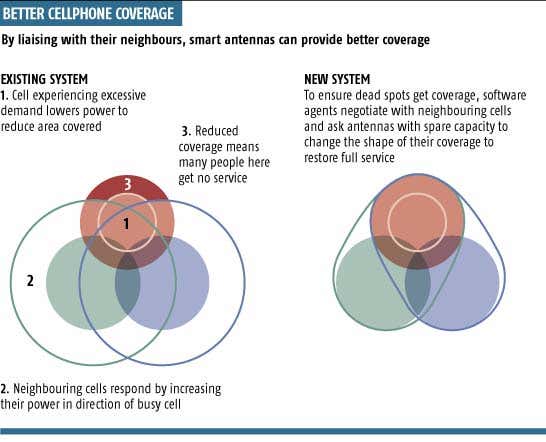
Advertisement
To see if the reality matches this claim, the Queen Mary team’s smart antennas will be tested this summer inside Athens International Airport during the Olympics, where they will form part of a system that gives air passengers some novel services.
Dead spots
The airport network will be a hybrid “2.5G” system encompassing some aspects of both conventional GSM and 3G. Called the Airport Decision and Management Network (Adamant), it is part of a European Union-funded project designed to reduce flight delays caused when airlines cannot contact passengers who are late boarding a plane.
Adamant uses a network of intelligent antennas to track passengers via their mobiles, alerting them to delays, queues at check-in or security, and how much time they have before departure. But for it to work reliably, it is essential that there are no coverage dead spots in the airport.
Dead spots occur when a cell in a network gets overloaded with phone calls and the antenna is forced to shrink its coverage area by cutting out some of the cellphone users on the edge of its range. It does this by lowering its transmission power.
One way to help those denied service is for neighbouring antennas to extend their coverage by boosting their power but this still leaves dead spots (see graphic). Cuthbert’s answer is to use a type of antenna, called a phased array, whose coverage pattern can be changed electronically, from a circle, say, to a long ellipse that could fill in a remote dead spot.
Autonomous agent
It is how this antenna is controlled that is crucial. It is no good expecting people in a control centre to decide where coverage needs expanding, as demand changes too often for them to keep up.
So the researchers have placed an autonomous software agent in charge of each antenna. Software agents are programs that cooperate with each other in unpredictable environments without human intervention. You might ask one to buy something on the web when the price is right, for instance, by negotiating with an agent on an e-commerce site.
In Adamant, if a cell has too many users, the software agent in charge of that cell simply negotiates with those in charge of neighbouring antennas, asking which can help. If a neighbour is not too busy, that antenna can “reach out” to those with no coverage. At least, that’s the idea that will be tested in Athens.
“In theory these antennas could provide additional capacity, but the technology is not proven yet,” warns Ed Brewster, spokesman for Three, the UK’s only 3G network.


