Opportunity has moved about one metre from its landing craft (Image: NASA/JPL)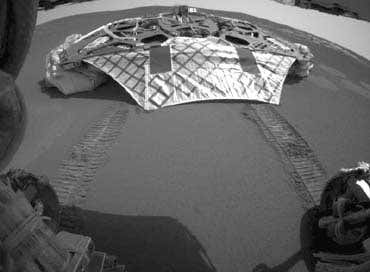
The Mars rover Opportunity, which rolled off its landing platform onto the Martian surface early on Saturday, has returned its first real science data to Earth.
The initial findings of the craft’s mini-Thermal Emission Spectrometer show that the mineral hematite is found in the upper, nubbly layer of the landing site’s wine-dark soil.
Hematite had been detected from orbit and was a key reason for the choice of the Meridiani Planum as a landing site. The iron oxide often, but not always, forms in the presence of liquid water.
Advertisement
The lighter patches of soil that were squashed flat by Opportunity’s landing show no signs of hematite at all, strongly suggesting it is in the dark surface pebbles, which were buried by the force of impact.
The principal investigator for mini-TES, Phil Christensen of Arizona State University, said he was delighted by the finding, because the orbital data left open the possibility that the hematite might be in the fine surface dust, carried by wind from some distant place.
But the indications are, he said, that it originates the prominent layer of dark rock ahead of Opportunity, and can therefore help reveal the site’s geological history.
Distinctive signature
The spectral signature of the hematite is distinctive, essentially ruling out any high-temperature formation process and leaving only low-temperature – roughly room temperature – scenarios. Christensen said that while this does not completely rule out a volcanic, water-free process for the hematite, it does make it less likely.
Perhaps the most intriguing finding from the mini-TES so far is its data from the light-coloured outcrop of bedrock seen just below the dark outcrops. The spectral features of the rock do not appear to match “any of the obvious things” says Christensen. It is not basalt, carbonate, or silicate, leaving the science team scrambling to figure just what it is.
Now that Opportunity is down in the dirt, it will begin studying the soil close up with its microscopes and spectrometers. Then, most probably by the end of the week, it will roll over to the outcrop and begin a similar suite of measurements of the bedrock.
Meanwhile, the twin rover Spirit is now back in full operation. It is expected to begin taking new measurements on Monday of a rock called Adirondack, after first either brushing or grinding its surface with the craft’s spinning Rock Abrasion Tool.