This magnified view of the Martian soil shows coarse grains sprinkled over a fine layer of sand – the view is 3 centimetres across (Image: NASA/JPL/US Geological Survey)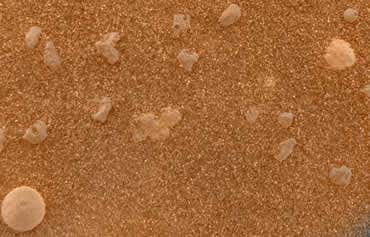
Thousands of tiny, perfectly rounded spheres have been seen on the dark soil around the Mars rover Opportunity.
The bead-like particles were seen in high-resolution images taken by the craft’s panoramic camera, and two of them were seen close up by its microscopic imager.
“The spheres are unlike anything we’ve ever seen on Mars,” said lead scientist Steven Squyres, and are intriguing because “there are only so many ways to make round things”.
Advertisement
They could be frozen drops of lava ejected by a volcanic eruption (called lapillae), frozen drops of rock melted and thrown out by a meteorite impact (called tektites), or, most excitingly, particles formed by slow chemical accretion in a body of water (called oolites).
Further close examination by the rover’s suite of instruments should help to pinpoint the mechanism of formation. For example, if the rover finds a cracked sphere and sees pearl-like concentric layering, the particles would be oolites.
However, some of the spheres appear to have holes in them, which suggests the escape of trapped gases from a molten blob and hence a volcanic or impact origin.
Field trip
In addition to the spheres, there are other pebbles on the surface that have a reddish colour. While much of Mars is covered in red dust, the underlying rocks are mostly dark, making these pebbles unusual. They may be weathering out of the outcrop of bedrock six metres from the lander.
In the early hours of Thursday morning, Opportunity moved about three metres forward, bringing it about halfway to the right-hand edge of the long outcrop. It is expected to complete the trip on Friday.
The rover will then spend several days travelling slowly along it, taking high-resolution, full-colour stereo images and infrared spectra of the finely layered rocks. These images will be then used to guide the science team in deciding which areas to investigate up close with the rover’s multiple instruments.
A detailed image already taken by the mini-TES infrared spectrometer shows some parts of the 22-metre crater in which Opportunity landed are very rich in hematite while others have virtually none. The presence of the iron-oxide mineral, which often forms in liquid water, was a major factor in choosing Opportunity’s landing site.
“Every shape, texture and colour has a story to tell” about the geological history of the area, said Squyres. “In the coming days, we’ll unravel the mysteries.”


