The fine layers and rounded grains are reminiscent of water-lain sedimentary rocks on Earth (Image: NASA/JPL)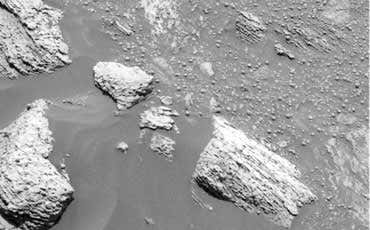
The Mars rover Opportunity has taken the first close-up pictures ever of Martian bedrock, and these reveal important new details of the intriguing strata. The rover’s earlier observations revealed layering, as well as round grains in the soil, both highly suggestive of sedimentary rocks deposited in water.
The new close-up images show that the thinness of the parallel layers of the rock continues down to the smallest scales the images are capable of showing. Furthermore, the small bead-like spheres seen earlier on the soil turn out to be heavily concentrated in the bedrock itself
The spheres are both “in the soil and in the outcrop”, said Jim Erickson, Opportunity mission manager, on Sunday. An earlier microscope image showed the spheres ranged up to three millimetres in diameter, and those seen in the new images appear similar.
Advertisement
Earlier in the mission, some team members had suggested that if rounded grains were found in the layered rock, that would strongly imply a sedimentary formation process in deep water subject to wave action. On Earth, waves can produce very smoothly rounded grains, which can then be buried and compressed into rock.
Concentric rings
However, a volcanic mechanism could also account for both the fine layering and the grains, with eruptions of ash alternating with eruptions of molten rock whose droplets hardened to form glassy spheres. But the absence of any known volcano in the region seems to make this less likely. Another possibility is sedimentary formation, but caused by wind, not water.
One observation that could resolve the issue would be to examine the inside of some of the spheres. Concentric rings would be a clear indication of an accretion process in water, while analysing their chemical composition could rule out a volcanic source.
Stephen Gorevan, designer of the rover’s Rock Abrasion Tool, told New Scientist on Sunday that the science team “have started to ask me for a place where we might set down” the RAT “and slice one of these spherules in half”.
Pure basalt
Opportunity’s twin rover, Spirit, used the RAT on Saturday morning to grind away the surface of a rock. It then took microscopic images and spectra of the rock’s interior.
This was to determine whether the rock was covered with a hard rind of different composition, but preliminary indications suggest not, Gorevan said. The rock may be almost pure basalt, a volcanic rock type seen by previous Mars missions.
On Sunday night, both rovers were set to begin moving again. Spirit, aimed to start its long drive away from its landing area and towards a 200-metre crater called Bonneville, which is about 250 metres away. If all goes well, Spirit could traverse as much as 20 metres in its first leg on Monday.
Opportunity is expected to move about three metres along the rock face, beginning its reconnaissance of the 30-metre outcrop along the interior of the crater in which it landed.
Topics: