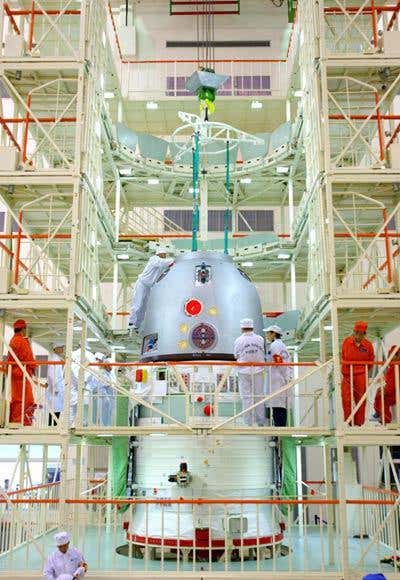
A soldier guards the Long March rocket before its launch on 12 October 2005, carrying Shenzhou VI into orbit (Image: MAXPPP/IMAGINECHINA) Engineers join the re-entry and propelling modules of Shenzhou IV at the Jiuquan centre on 30 July 2005 (Image: MAXPPP/IMAGINECHINA)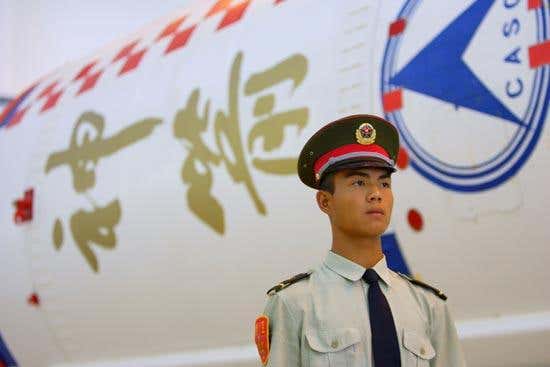
China’s space programme has reached maturity with a five-day orbital mission for a pair of “taikonauts” – but the march to space has been a long one.
1956: China, still an overwhelmingly poor and rural society, opens its first Missile and Rocket Research Institute.
1957: The Chinese government kicks off Mission 581, a programme aimed at launching satellites.
Advertisement
1960: China develops its first rocket, aided by Russian scientists. It is the first of a series of rockets, all named CZ (for changzheng, or “long march”).
1964: Four albino rats, four white mice and 12 tubes of biological samples are put on a T-7A-S rocket, which reaches an altitude of 70 kilometres.
1968: An institute for medical and space engineering opens in Beijing. It is charged with conducting research into human spaceflight.
1970: On 24 April, China becomes the fifth country in the world to send a satellite into orbit, as the DFH-1 is lifted into space on board a Long March rocket. The Soviet Union launched the first-ever satellite, Sputnik, in 1957.
1980: Several official newspapers carry articles and photos describing preparations for crewed space flight. But the project never materialises, apparently because of budget constraints.
1984: A new launch site opens in Xichang, in south-western China’s Sichuan province.
1988: Another launch site opens at Taiyuan in north China.
1992: As China makes crewed spaceflight its mid to long-term objective, the State Council adopts Project 921. This is as secretive as past projects and later goes by the name Shenzhou (“divine vessel”).
MORE: Read about the latest launch, Shenzhou, the “divine ship” and its desert launch site, a sprawling oasis in the Gobi desert.
1993: Chinese officials visit Russia’s space programme.
1994: The CZ-2D rocket lifts off, carrying several small animals.
1995: China’s space programme suffers a setback when a CZ-2E rocket explodes after take-off from Xichang, killing at least six people on the ground.
1996: China signs an agreement for the acquisition of Russian space technology.
1997: Two Chinese men, Wu Jie and Li Jinlong, complete a year of training at Russia’s Star City and become qualified as space-flight instructors. A mission control centre opens in Beijing.
1998: The development of a Shenzhou space vessel is announced.
1999: The Shenzhou spacecraft is launched on 20 November on a CZ-2F rocket and returns to Earth after 14 orbits. It carries several kilograms of biological samples.
2000: The Shenzhou is shown to the public for the first time in Hong Kong.
2001: Shenzhou II blasts off on 9 January, carrying microbes and several small animals. The capsule returns to Earth on 16 January, touching down in the Inner Mongolia region.
2002: Shenzhou III is launched on 25 March in the presence of President Jiang Zemin. On 1 April, after orbiting the Earth 108 times, the craft returns. Shortly afterwards, Beijing announces plans for a space station. On 29 December, Shenzhou IV is sent into orbit, and returns to Earth six days later.
2003: On 15 October, Shenzhou V blasts into orbit, carrying China’s first man in space, Yang Liwei. He returns after 21 hours and 14 trips around the Earth.
2004: Wang Yongzhi, the chief designer of China’s space programme, says China aims to have a permanent crewed space station within 15 years.
2005: On 12 October Shenzhou VI blasts off for a five-day mission carrying two taikonauts.


